USAID
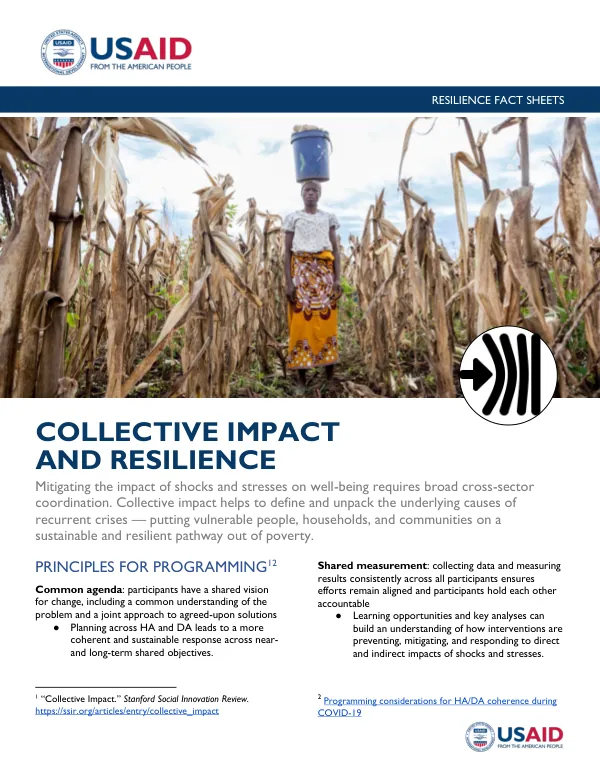
COLLECTIVE IMPACT AND RESILIENCE
Collective Impact initiatives aim to mitigate the impact of shocks and stresses on well-being by promoting broad cross-sector coordination.
2020 · 3 pages
Sign in to readA free account is required to download.
Abstract
This approach helps define and unpack the underlying causes of recurrent crises, enabling vulnerable people, households, and communities to transition to a sustainable and resilient pathway out of poverty. A key principle of Collective Impact is the establishment of a common agenda among participants, which includes a shared vision for change, a common understanding of the problem, and a joint approach to agreed-upon solutions. This shared understanding enables planning across humanitarian assistance (HA) and development assistance (DA) to result in a more coherent and sustainable response across near- and long-term shared objectives. Shared measurement is another essential principle of Collective Impact, as it involves collecting data and measuring results consistently across all participants to ensure efforts remain aligned and participants hold each other accountable. This approach facilitates learning opportunities and key analyses, which can build an understanding of how interventions are preventing, mitigating, and responding to direct and indirect impacts of shocks and stresses. Collective outcomes are quantifiable, measurable results that DA and HA actors can achieve in 3-5 years. Articulating outcomes for populations of mutual concern requires communication, coordination, and joint planning. Mutually reinforcing activities, such as differentiated but coordinated activities, enable participants to address problems with multiple causes and solutions. Continuous communication is also crucial, as consistent and open collaboration is needed to build trust, assure mutual objectives, and ensure shared motivation. Backbone support is another critical component of Collective Impact, as funding a dedicated, independent entity or team helps maintain overall strategic coherence, coordination, and management of operations and implementation. This support mechanism facilitates collaboration and learning, ensuring that activities are mutually reinforcing and enable collective action. A dedicated USAID advisor or coordinator can operate across sectors, building trust and legitimacy in coordination, and requiring strong skill sets in communication, relationship, and knowledge management. In Kenya, the Partnership for Resilience and Economic Growth (PREG) program unites multiple USAID programs and implementing partners to coordinate resilience and economic growth activities. PREG's partnership model links and coordinates diverse humanitarian and development activities working with the same people in shared geographies, allowing USAID and partners to adapt and leverage knowledge and resources. The approach coordinates regionally to improve livelihoods and governance, strengthen livestock value chains, enable access to water sources and water, sanitation, and hygiene services, increase conservation measures, address conflict, and promote inclusiveness and gender responsiveness. In Burkina Faso and Niger, the Resilience in the Sahel Enhanced (RISE) II program focuses on resilience capacities, with an investment of $730 million over five years. USAID's approach consists of strategically overlapping and sequencing humanitarian and resilience interventions, as well as developing and implementing separate activities according to the needs of the communities. The program integrates a global approach to risk management, strengthening local capacities to prepare for, respond to, and recover from shocks. In South Sudan, the Partnership for Recovery and Resilience (PfRR) unites donors, UN agencies, and non-governmental organizations at both national and local levels to ensure that support reaches the communities and households that require it. PfRR's partnership model links and coordinates diverse partner activities working with the same people in shared geographies, allowing for donors, UN entities, and NGOs to adjust as communities increase resilience over time. PfRR collaborates, co-locates, and coordinates programming around four pillars: re-establishing access to basic services, rebuilding trust in people and institutions, restoring productive capacities, and nurturing effective partnerships.
Related documents