INTERNATIONAL ORGANIZATION FOR MIGRATION
Colombia’s Ceasefire Agreement: Early Reintegration of FARC Members
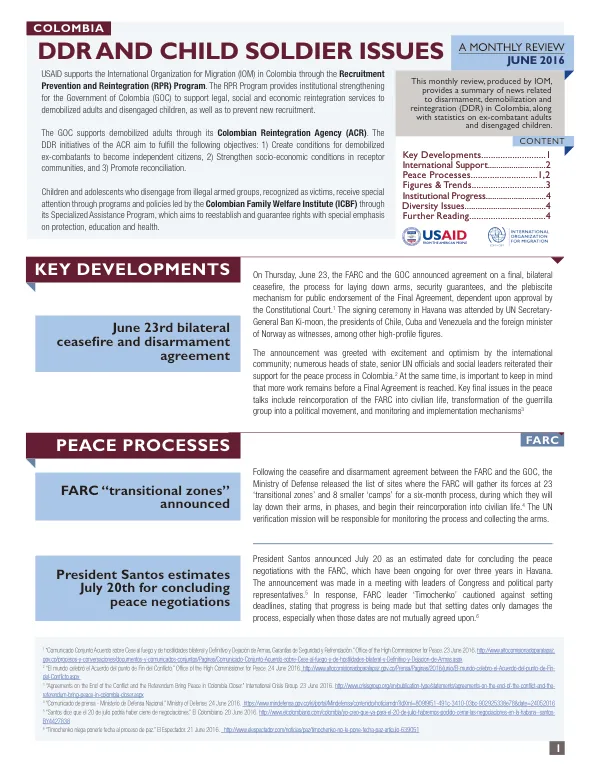
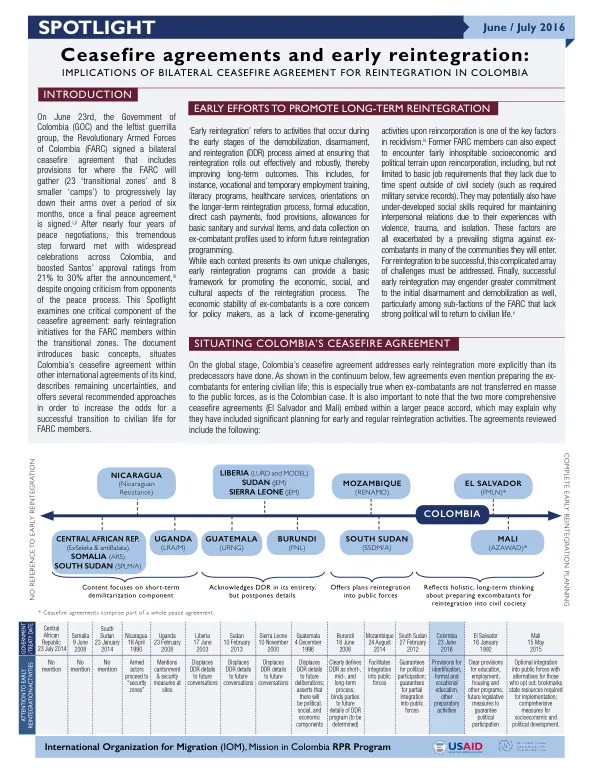
The June 23rd ceasefire agreement between the Government of Colombia (GOC) and the Revolutionary Armed Forces of Colombia (FARC) marks a significant step forward in the country's peace process.
2016 · 2 pages
Sign in to readA free account is required to download.
Abstract
The agreement includes provisions for the FARC to gather in transitional zones and camps, where they will progressively lay down their arms over a period of six months. This development has been met with widespread celebrations across Colombia, boosting President Santos' approval ratings from 21% to 30%. The ceasefire agreement addresses early reintegration initiatives for FARC members within the transitional zones. Early reintegration refers to activities that occur during the early stages of the demobilization, disarmament, and reintegration (DDR) process, aimed at ensuring that reintegration rolls out effectively and robustly. This includes vocational and temporary employment training, literacy programs, healthcare services, orientations on the longer-term reintegration process, formal education, direct cash payments, food provisions, allowances for basic sanitary and survival items, and data collection on ex-combatant profiles used to inform future reintegration programming. Colombia's ceasefire agreement is notable for its explicit mention of early reintegration activities, which is a departure from its predecessors. The agreement includes provisions for preparatory activities within the transitional zones, such as training on productive labors, basic primary, secondary, or technical education, sessions for the issuance of identification cards, and other preparatory activities designed to prepare FARC members for reincorporation and to facilitate the transition to legality. However, many questions remain as to how the GOC will realize these preparatory activities and how the FARC guerrillas will receive them. Drawing on lessons learned from both the Colombian and international contexts, several recommendations are offered to improve the odds of success in transition. These include setting clear expectations among all involved parties regarding what can and cannot be reasonably accomplished within the time and budget constraints of the transitional zones, approaching workshops and courses within the transitional zones through a holistic lens, and addressing early reintegration services using tailored approaches that adjust content and delivery based on age, gender, sexual orientation, ethnicity, and disability. The transitional zones offer an ideal moment to begin building skills that will be essential for FARC members to find and keep a job upon leaving the zones. Ongoing review and oversight of early reintegration programs will support more effective program implementation within the transitional zones, allowing both policy makers and transitioning FARC members greater continuity throughout the earliest stages of their entry to civilian life. This continuity can contribute to greater stability over the long-term. The Colombian government and the FARC have committed to implementing measures and preparatory activities within the transitional zones, which will include all kinds of training for FARC members on productive labors, basic primary, secondary, or technical education, sessions for the issuance of identification cards, and other preparatory activities designed to prepare FARC members for reincorporation and to facilitate the transition to legality. The success of these initiatives will depend on the ability of the GOC and the FARC to work together effectively and to address the complex challenges that FARC members will face upon leaving the transitional zones. The international community has a significant role to play in supporting the Colombian government and the FARC in their efforts to implement the ceasefire agreement and to ensure a successful transition for FARC members. This includes providing technical assistance, financial support, and capacity-building programs to help the GOC and the FARC to develop and implement effective early reintegration programs. By working together, it is possible to create a more stable and peaceful future for Colombia and its people.
Related documents