USAID DEC
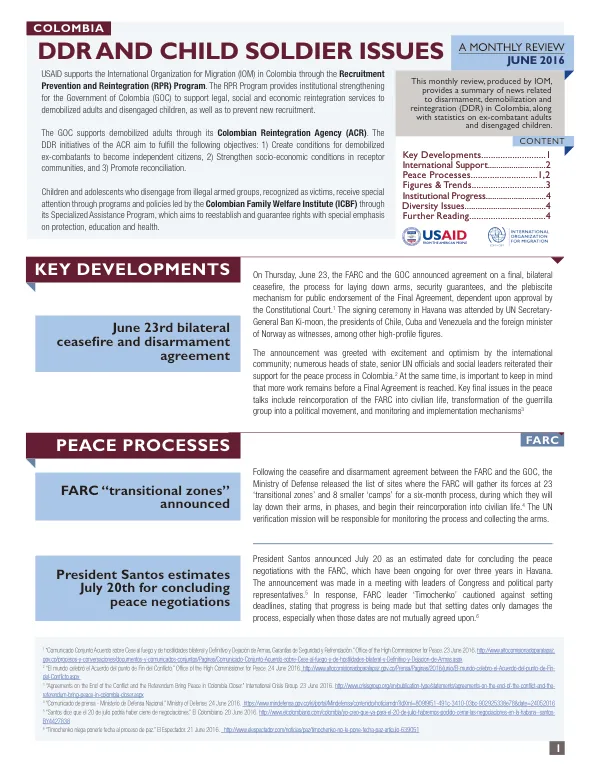
USAID supports International Organization for Migration (IOM) in Colombia through the Recruitment Prevention and Reintegration (RPR) Program
Sign inINTERNATIONAL ORGANIZATION FOR MIGRATION
USAID supports International Organization for Migration (IOM) in Colombia through the Recruitment Prevention and Reintegration (RPR) Program
The Colombian government, through the Colombian Reintegration Agency (ACR), supports the demobilization, disarmament, and reintegration (DDR) of demobilized adults and disengaged children.
2016 · 4 pages
Sign in to readA free account is required to download.
Abstract
The ACR aims to create conditions for demobilized ex-combatants to become independent citizens, strengthen socio-economic conditions in receptor communities, and promote reconciliation. The Colombian Family Welfare Institute (ICBF) leads programs and policies to provide special attention to children and adolescents who disengage from illegal armed groups, recognized as victims. The FARC and the Colombian government announced a bilateral ceasefire and disarmament agreement on June 23, 2016. The agreement includes the establishment of transitional zones for the FARC to lay down their arms and begin their reintegration into civilian life. The United Nations will monitor the process and collect the arms. The Colombian government has set July 20 as an estimated date for concluding peace negotiations with the FARC. The ELN, Colombia's second-largest guerrilla group, has been involved in kidnappings, which have hindered the start of peace talks between the ELN and the Colombian government. The ELN has called for inclusion in the bilateral ceasefire agreement announced with the FARC, despite the continued practice of kidnappings. Colombian NGOs and activists have urged the ELN to cease kidnappings and release hostages before formal peace talks can begin. International support for the peace process in Colombia has been significant. The United States, Canada, and Mexico have committed to providing strong support for the peace accords, with particular attention to the demining process. The United States has offered $33 million and technical support for demining operations in zones under guerrilla influence. A group of 23 UN observers arrived in Bogota to set up the verification mission. According to data up to June 30, 2016, the total number of disengaged minors in Colombia is significant. Boys have been more frequently recruited than girls, and most disengaged children were recruited by the FARC. The data highlights the need for targeted programs and policies to support the reintegration of minors who have been involved in armed groups. The Colombian government has made significant efforts to promote the DDR process, including the establishment of the ACR and the ICBF. The government has also committed to providing support for the reintegration of demobilized ex-combatants and disengaged children. International support has been crucial in promoting the peace process in Colombia, and the Colombian government has made significant progress in implementing the DDR process. The peace process in Colombia has been marked by significant challenges, including the continued practice of kidnappings by the ELN. However, the Colombian government has remained committed to promoting the DDR process and has made significant progress in implementing the peace accords. International support has been crucial in promoting the peace process, and the Colombian government has made significant efforts to promote the reintegration of demobilized ex-combatants and disengaged children. The Colombian government has established transitional zones for the FARC to lay down their arms and begin their reintegration into civilian life. The United Nations will monitor the process and collect the arms. The Colombian government has set July 20 as an estimated date for concluding peace negotiations with the FARC.