USAID
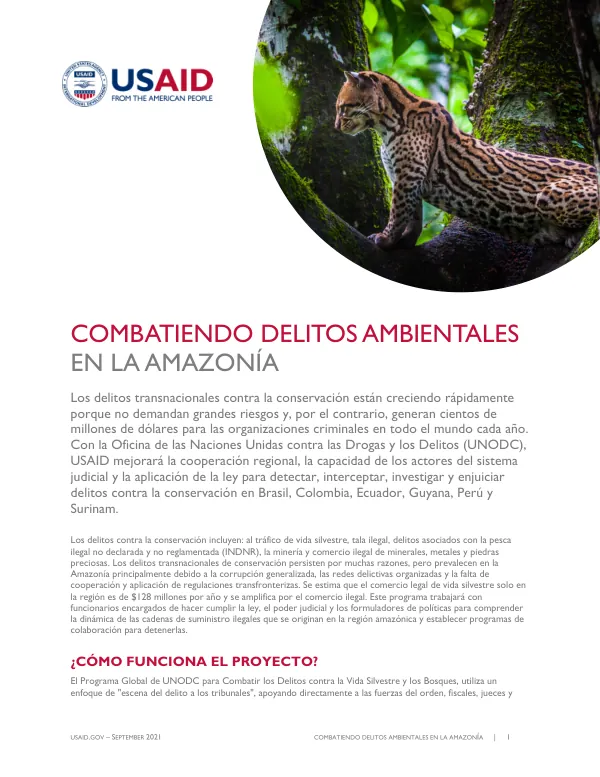
Combatiento Delitos Ambientales en la Amazonía
The combat against environmental crimes in the Amazon region is a growing concern due to the increasing demand for natural resources and the lack of effective law enforcement.
2021 · 2 pages
Sign in to readA free account is required to download.
Abstract
Transnational crimes against conservation are on the rise, generating hundreds of millions of dollars for criminal organizations worldwide each year. The United Nations Office on Drugs and Crime (UNODC) is partnering with the United States Agency for International Development (USAID) to improve regional cooperation, judicial capacity, and law enforcement to detect, intercept, investigate, and prosecute environmental crimes in Brazil, Colombia, Ecuador, Guyana, Peru, and Suriname. Environmental crimes include wildlife trafficking, illegal logging, and crimes associated with unreported and unregulated fishing (INDNR), as well as illegal mining and trade of minerals, metals, and precious stones. These transnational crimes persist due to widespread corruption, organized crime networks, and the lack of cooperation and enforcement of cross-border regulations. The estimated annual legal trade of wildlife in the region is $128 million, which is amplified by illegal trade. The program will work with law enforcement officials, the judiciary, and policymakers to understand the dynamics of illegal supply chains originating in the Amazon region and establish collaboration programs to combat them. The UNODC's Global Programme to Combat Wildlife and Forest Crime uses an "crime scene to court" approach, directly supporting law enforcement, prosecutors, judges, and wildlife authorities to improve national, regional, and international penal justice and implement preventive responses to environmental crimes. The UNODC will apply this approach in the Amazon region, directing action throughout the entire criminal chain, linking justice and law enforcement efforts at the local, national, and regional levels. To reduce environmental crimes and the national and international trade of illegally collected natural resources, the UNODC and USAID's Amazon Regional Environmental Program (AREP) will work on three main objectives: (1) strengthening transnational law enforcement coordination in triple-border areas; (2) strengthening penal provisions within relevant legal frameworks; and (3) strengthening effective investigations and prosecutions of conservation crimes at the national level. The UNODC will implement the activity in six countries in the region, focusing on triple-border areas. The expected outcomes of the project include establishing a reference framework on the scope of transnational crimes against conservation in the six project countries, including analysis of how wildlife trafficking, money laundering, illegal logging, and other criminal networks overlap in complex networks. The project aims to increase the professionalism and capacity of justice actors in preparing successful prosecutions for conservation crimes in the triple border area, increase transnational law enforcement coordination through the use of specialized research techniques and the increase in the number of transborder operations, and increase interdiction and prosecution of criminal actors. Additionally, the project aims to reduce illegal trafficking, illegal mining, unreported and unregulated fishing, and illegal logging, and to establish the South American Wildlife Enforcement Network (SudWEN), a regional organization composed of law enforcement actors in natural resources.