USAID DEC
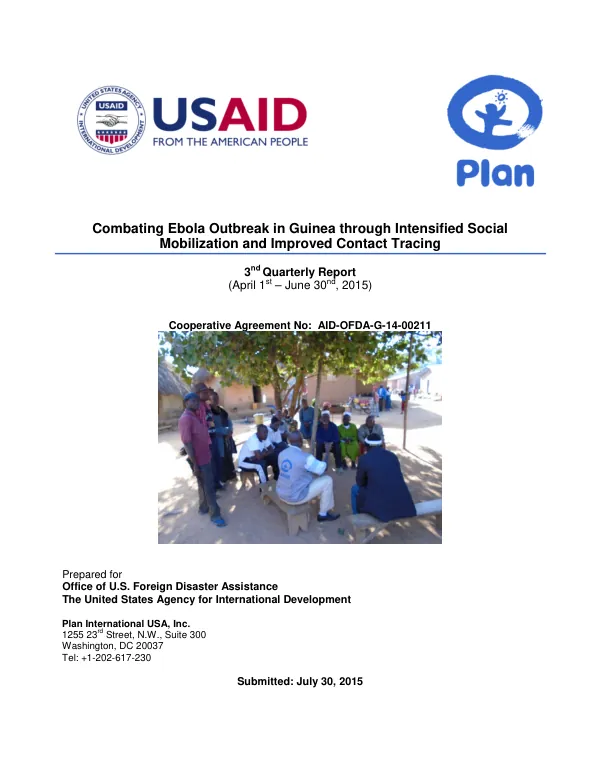
Combating Ebola Outbreak in Guinea through Intensified Social Mobilization and Improved Contact Tracing 3nd Quarterly Report (April 1st – June 30nd, 2015)
Sign inPLAN INTERNATIONAL USA
Combating Ebola Outbreak in Guinea through Intensified Social Mobilization and Improved Contact Tracing 3nd Quarterly Report (April 1st – June 30nd, 2015)
The Ebola outbreak in Guinea began in February 2014, with the first identified cases occurring in the southeast of the country.
2015 · 9 pages
Sign in to readA free account is required to download.
Abstract
Following confirmation of the disease, the Government of Guinea officially declared the outbreak on March 22, 2014. The spread of the epidemic was rapid and unpredictable, with 14 districts, including the capital city of Conakry, affected by the disease. As of September 10, 2014, there were 716 confirmed cases of Ebola infection across Guinea, resulting in a death toll of 413 confirmed and 155 probable fatalities. The nationwide fatality rate was approximately 63%. The lack of appropriate information and low level of awareness of preventive measures among the general public created a major risk of increased transmission of the Ebola virus throughout Guinea. An inadequate contact tracing system within the country, compounded by insufficient staffing and resources, further impeded efforts to limit the spread of the outbreak. In response, Plan began implementation of an OFDA-funded project to intensify public communication and contact tracing in order to break the chain of transmission of Ebola in Guinea. The project's results analysis of basic surveys on perception, knowledge, attitude, and behavior of the population in the face of the epidemic indicated that a sizable majority of the population recognized the lethality of the Ebola epidemic. Large majorities also reported knowledge that the sick and the bodies of those who died from Ebola remained the major sources of transmission, as well as that washing hands with soap and chlorine was a major measure to help avoid transmission of the disease. Key accomplishments during the reporting period included the distribution of soap and bleach to households, the installation of hand washing stations in schools, and the supervision of the effectiveness of these stations. The project's interpersonal communication activities targeted a total of 111,368 households, equivalent to 402,433 individuals, including 228,858 adults and 173,575 children. This specific activity had a key impact on reducing community resistance to following a handwashing regimen in Télimélé prefecture. The project also conducted a second awareness campaign and active search of cases from May 16th to May 19th, 2015, in all communities of Forecariah, resulting in 73 alerts, including 29 community death cases and 39 suspect cases. In all cases of death, the deceased were provided a safe and decent burial. The project's distribution of soap and bleach to schools aimed to cover the rest of the school year, with 5,722 cartons of soap distributed. Supervision of the effectiveness of the hand washing stations and the activity of awareness on the methods of prevention of Ebola virus in schools was carried out from June 8th to June 26th, 2015, in 65 schools and 10 prefectures. The students in the visited schools demonstrated familiarity with measures to prevent transmission of Ebola, and the hand washing stations were observed to be in regular use during visits. Plan Guinea's Quality Assurance department visited target schools to confirm receipt and use of handwashing stations and supplies, and a mission was conducted to test internal controls of the CECOJe of 9 prefectures to ensure compliance of procedures in relation to administrative and financial management.