JHPIEGO
MCSP Guinea Ebola Response II - Quarterly Report (Apr – Jun 2015)
The Maternal and Child Survival Program (MCSP) in Guinea is a global U.S.
2015 · 11 pages
Sign in to readA free account is required to download.
Abstract
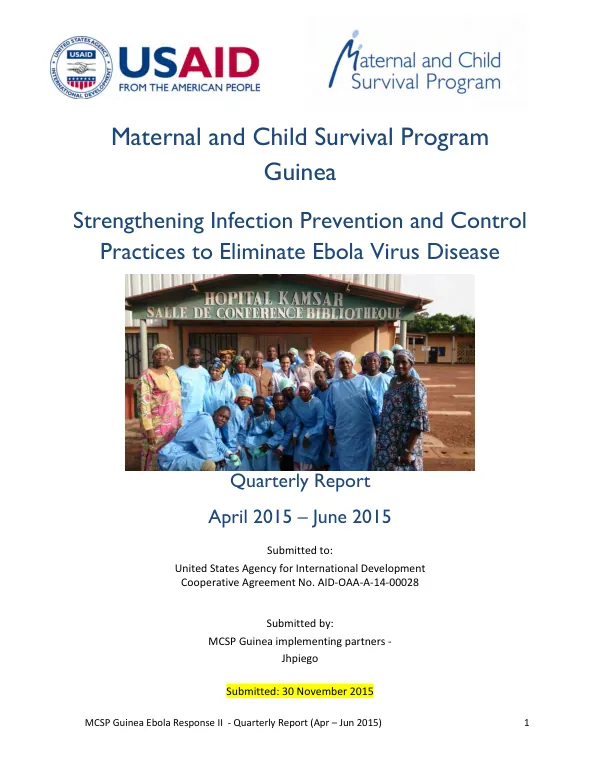
Agency for International Development (USAID) cooperative agreement aimed at introducing and supporting high-impact health interventions in 24 priority countries. The ultimate goal of the program is to end preventable maternal and child deaths within a generation. MCSP carries forward the momentum and lessons learned from the highly successful USAID-funded Maternal and Child Health Integrated Program (MCHIP), which has made significant progress in improving the health of women and children in over 50 developing countries. MCSP interventions in Guinea focus on building local training capacity among healthcare providers, with a focus on competency-based training methods that improve both knowledge and skills. These interventions build on previous work specifically on infection prevention practices in healthcare facilities and a commitment to quality improvement and supportive mentoring and supervision to assist healthcare providers in translating new skills into ongoing practice at their worksites. Jhpiego, an affiliate of Johns Hopkins University, is leveraging the achievements of previous and ongoing projects to improve and extend activities strengthening infection prevention and control (IPC) initiatives in prefectures that currently lack donor support. The project is building upon MCSP's comprehensive IPC training and supportive supervision activities in Conakry, Beyla, Kissidougou, and Forécariah prefectures, which since December 2014 have trained 999 health workers in 55 targeted health structures. The activities under MCSP are designed to support the achievements of Guinea's MCHIP program, which was implemented from October 2010 to March 2014 and increased the capacity of health workers in health facilities and in the community to offer family planning (FP), as well as maternal, newborn, and child health (MNCH) services. The USAID Mission in Guinea has been developing a new health financing mechanism and requested the assistance of MCSP to fill the gap by supporting the Ministry of Health. The goal of the MCSP Ebola Response Project in Guinea is to scale up efforts to prevent and control the spread of Ebola Virus Disease (EVD) to protect and maintain quality reproductive, maternal, newborn, and child health services. The key objective of this activity is to work with the Ministry of Health and key partners to support healthcare workers and facilities to continue to offer high-quality health services in a safe environment by strengthening infection prevention and control (IPC) practices through training, supportive supervision, and complementary monitoring and evaluation. A rapid assessment of IPC performance was conducted in 13 targeted health facilities to understand current IPC practice, identify barriers to the implementation of IPC standards, and review the availability of equipment, consumables, and existing personal protective equipment (PPE). The results of the assessment revealed low performance in IPC practice and management, with scores ranging from 0% to 31% in health centers. The performance standard evaluating the availability of antiseptics and disinfectants for at least a month was the only standard achieved in the majority of sites. At Boké regional hospital, the following standards were achieved in over 50% of the departments/health services: availability of an access point for clean water, availability of antiseptics and disinfectants for at least one month, effective preparation and sterilization process, appropriate IPC provisions for laundry/laundry room, and the presence of an incinerator or a functional pit for final disposal of waste. The following standards that were not achieved by more than 50% of services at Boké regional hospital include availability of equipment and supplies in sufficient quantities for maintenance, at least one month's supply of PPE material and equipment available, decontamination of instruments and other items completed correctly, availability of IPC guidelines (posted and visible), and availability of equipment and supplies for proper hand washing in all examination rooms. At Anaim business hospital, the IPC performance scores ranged from 24% (general medicine) to 60% (Ondo-stomatology), with 5 out of 11 services (or 45%) achieving performance scores that exceeded 50%.