USAID DEC
Combining household and price data to target food marketing interventions in Nigeria
Sign inFOOD AND AGRICULTURE ORGANIZATION OF THE UNITED NATIONS IN GEORGIA
Combining household and price data to target food marketing interventions in Nigeria
The agricultural development initiative in Nigeria began with a focus on improving food marketing interventions.
2021 · 13 pages
Sign in to readA free account is required to download.
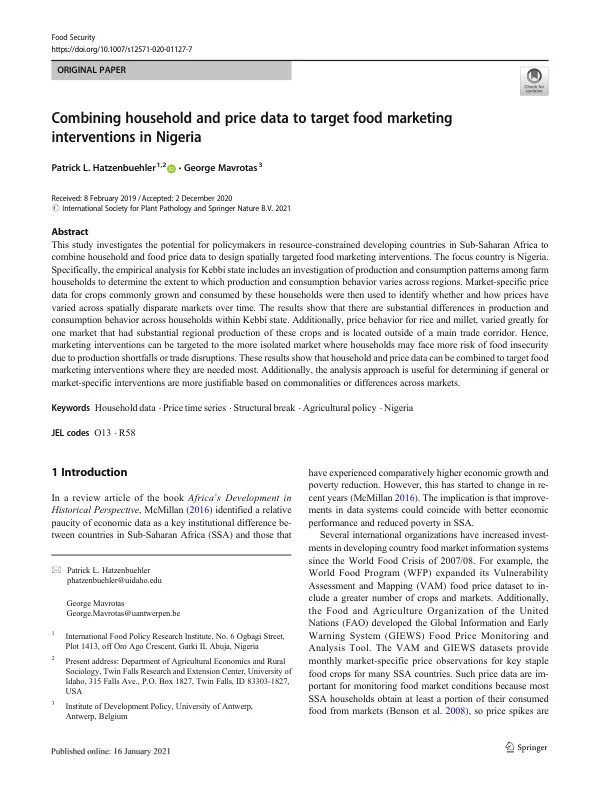
Abstract
The study aimed to combine household and price data to design spatially targeted food marketing interventions in the country. The research focused on Kebbi state, where production and consumption patterns among farm households were investigated to determine the extent to which these behaviors varied across regions. Market-specific price data for crops commonly grown and consumed by these households were used to identify whether and how prices had varied across spatially disparate markets over time. The results showed that there were substantial differences in production and consumption behavior across households within Kebbi state. Additionally, price behavior for rice and millet varied greatly for one market that had substantial regional production of these crops and was located outside of a main trade corridor. This market, which was more isolated, faced a higher risk of food insecurity due to production shortfalls or trade disruptions. The results showed that marketing interventions could be targeted to this market where households may face more risk of food insecurity. The analysis approach was useful for determining if general or market-specific interventions were more justifiable based on commonalities or differences across markets. The study built on previous research that had empirically examined the relationship between household food production and consumption and used price data for market condition assessments. Empirical analyses of SSA farm household food production and consumption had increased in number since 2009 due to the dissemination of the LSMS-ISA household datasets. Many of these studies included estimates of the relationship between consumption diversity, a proxy for nutritional quality, and production diversity, a commonly employed risk mitigation strategy among smallholder farmers. The study's objectives were to determine if there were sufficient differences across market areas regarding household food production and consumption practices to indicate that changes in prices would be more pronounced in some areas, and if there was substantial enough market price behavior to allow for identification of markets that could be targeted for marketing interventions. The first research objective was achieved through an assessment of household data on production and consumption patterns for cereals, while the second objective was achieved through an analysis that tested for structural breaks in cereal price time series for individual markets in the regions that matched the household data. The results of the study demonstrated how to identify the crops and individual markets for which policymakers can focus on the design of targeted food marketing interventions. The study's findings highlighted the importance of combining household and price data to design spatially targeted food marketing interventions in Nigeria. The results showed that there were substantial differences in production and consumption behavior across households within Kebbi state, and that price behavior for rice and millet varied greatly for one market that had substantial regional production of these crops and was located outside of a main trade corridor. The study's approach was useful for determining if general or market-specific interventions were more justifiable based on commonalities or differences across markets. The results of the study demonstrated the potential for policymakers to use household and price data to design targeted food marketing interventions in Nigeria. The study's findings highlighted the importance of improving food marketing interventions in Nigeria, particularly in regions where households face a higher risk of food insecurity due to production shortfalls or trade disruptions. The study's results showed that there were substantial differences in production and consumption behavior across households within Kebbi state, and that price behavior for rice and millet varied greatly for one market that had substantial regional production of these crops and was located outside of a main trade corridor. The study's approach was useful for determining if general or market-specific interventions were more justifiable based on commonalities or differences across markets.
Related documents
Documents in this collection
 2018
2018USAID DEC
Feed the Future Innovation Lab for Food Security Policy Policy Research Brief 83
Open record 2021
2021USAID DEC