FHI 360
ComCHASS Yr 2 Report
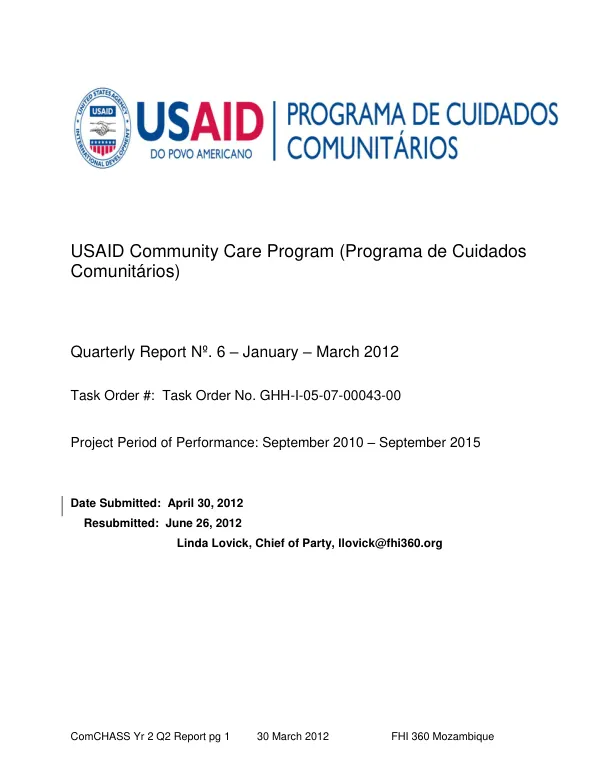
The Community Care Program (CCP) in Mozambique has witnessed significant expansion and growth across various levels of the project in the reporting period.
2012 · 42 pages
Sign in to readA free account is required to download.
Abstract
At the community level, the range of services available to families has been broadened and strengthened. Two recent services, Prevention of Mother-to-Child Transmission (PMTCT) and nutrition, have expanded their reach within the geographic areas. Nutrition services have undergone a different type of expansion, from being a component of the Home-Based Care (HBC) and Orphans and Vulnerable Children (OVC) minimum packages to a reportable deliverable under a PEPFAR indicator. The primary factors contributing to the project's effectiveness in achieving results have been Technical Assistance on implementing PMTCT services referrals, and an emphasis on HBC and Integrated Caregiver trainings on nutritional services activities, especially nutrition education, as well as proper reporting. Keystone services such as HBC and care for OVC continue to show positive trends. HBC enrollment has increased to 7,245 clients, with 2,043 new clients enrolled in the past quarter. Care and support for OVC may be the most sensitive area of CCP programming, with the most change in approach, innovation, and steepest learning curve for quality. The project coverage has expanded to 48 of the 52 districts, with the aim of completing full coverage by the next quarter. Fifteen new sites were added during this reporting period, and are in various stages of start-up, such as finalizing the Scope of Work, training the activistas, or implementing. New local partners in Tete, Niassa, and Sofala provinces completed the start-up activities, which included reviewing monitoring and evaluation tools and reporting requirements to track program progress. Grassroots community structures such as Community Care Committees and Community Leaders Councils were inventoried this quarter. This assessment identified existing and functional committees and their leadership and operations. These committees are crucial for the long-term sustainability of community-based responses to HIV. The project has also supported national-level trainings, which included a total of 10 trainings to roll out the Integrated Caregiver HBC/OVC program in Tete, Niassa, and Sofala for newly subgranted CSOs. Four additional training of trainers were completed by ANEMO to further grow the pool of qualified trainers in home-based care in Tete and Niassa province. Eleven trainings on the OVC minimum package were held in Tete, Inhambane, Manica to strengthen activistas and supervisors on the delivery of OVC services. The project has also strengthened government service providers and deepened collaborative relationships through joint supervision activities and supervision activities continue to be strengthened by the inclusion of government personnel from the provincial and district health and social directorates in trainings. The consortium meets routinely to share successes and challenges as the project moves into full implementation across seven provinces. The Community Care Program is designed to strengthen the community-based response to HIV/AIDS in seven provinces and improve the health and quality of life of people living with HIV (PLHIV), orphans and vulnerable children (OVC), and pre- or post-partum women, and their families. Working in close partnership with civil society organizations (CSOs), the Ministry of Health (MoH), the Ministry of Women and Social Action (MMAS), and the private sector, the Program aims to strengthen the government's capacity to coordinate, manage, and oversee an integrated continuum of care and support and build the capacity of CSOs to provide comprehensive, community-based care and support services. The program will achieve for PLHIV, pre- or post-partum women, OVC, and their families, all expected results: increased provision of family-centered, community-based HIV care and support services and increased access to economic strengthening and resources for HIV-affected households within five years.