SAVE THE CHILDREN FEDERATION/US
Resilience Food Security Activity FY23 Q1 Performance Report
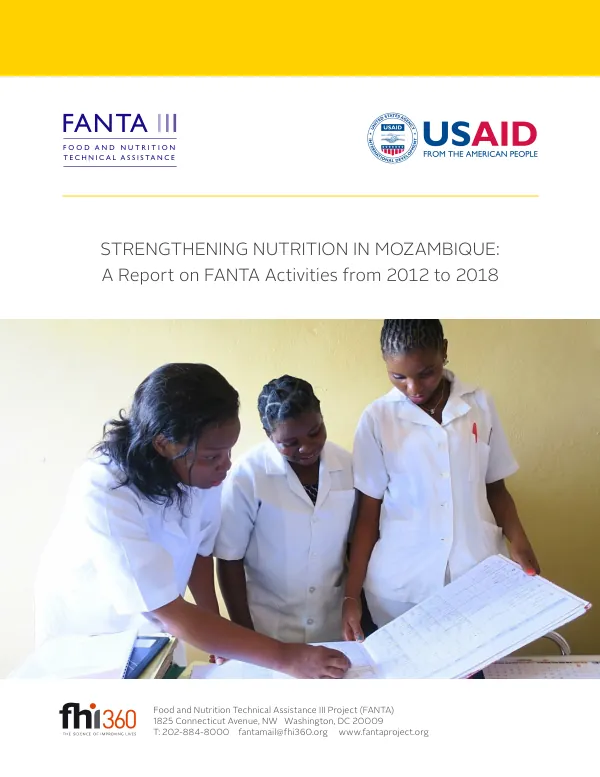
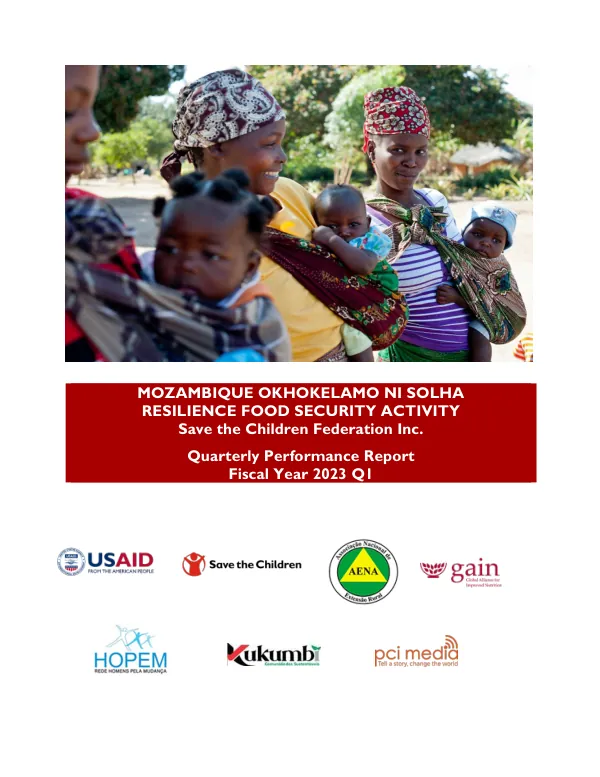
The Okhokelamo ni Solha Resilience Food Security Activity is a 5-year program launched by Save the Children (SC) and its partners in September 2022.
2023 · 5 pages
Sign in to readA free account is required to download.
Abstract
The program aims to sustainably improve nutrition outcomes for children under 2 years of age (CU2) in Zambezia Province, Mozambique. The program will take a life-stages approach to strengthen the skills, capacity, agency, resilience, and confidence of women and adolescent girls, while also engaging adolescent boys, husbands, fathers, and the community at large for collective action to achieve this goal. The program plans to reach 1,157,575 participants, members of vulnerable and very vulnerable households, in six districts of Zambezia Province. Save the Children and its partners, including Associação Nacional de Extensão Rural (AENA), Global Alliance for Improved Nutrition (GAIN), Rede Homens pela Mudança (HOPEM), Kukumbi, and PCI Media, will implement the activity focusing on women's and girl's roles as current or future mothers, but also as individuals with specific nutritional and developmental needs and their own hopes for the future. The program posits a three-part theory of change (TOC): Objective 1 focuses on the mother, increasing her capacity to support healthy behaviors through the life cycle, improving access to and use of quality reproductive, maternal, newborn, child and adolescent health and nutrition (RMNCAHN) services, and increasing her agency and resilience. Objective 2 focuses on the child, improving families' access to nutritious food year-round and infant and young child feeding (IYCF) behaviors at household and community levels. Objective 3 focuses on the adolescent girl, improving her access to and use of quality adolescent sexual and reproductive health (ASRH) and nutrition services, and increasing her assets, agency, and contribution in the household and community. In the first quarter of Fiscal Year 2023, the Okhokelamo ni Solha team established the main Activity office in Quelimane, expanded and converted the existing Save the Children office building for Zambezia Province into the Activity office, and identified regional offices in Mocuba and Alto Molocue. Key Personnel position recruitments were completed for the Chief of Party, Monitoring and Evaluation Lead, Strategic Learning Advisor, Social and Behavior Change Lead, and Gender and Youth Lead. Recruitment for the remaining Key Personnel, Nutrition Technical Lead, was relaunched due to the de-commitment of the approved candidate prior to his start date. The team also conducted a Stakeholder Inception Meeting in Quelimane, bringing together consortium partners, representatives of the Ministry of Health, Provincial Directorate of Health of Zambezia, and USAID representative. The team presented the project's TOC, target groups, main activities, and community actors, and participants provided valuable inputs that were subsequently used to enhance the ongoing work of identification of information gaps and theory of change tune-up. Sub-Award Agreements (SGAs) were signed between SC and AENA, HOPEM, and Kukumbi, and first instalments were disbursed to these partners. Final adjustments to SGAs for GAIN and PCI Media are being made and it is expected that these will be signed in Q2. The team also conducted several activities to prepare for the Inception Workshop and Gender, Social Inclusion, and Youth Consultation, including a TOC "Tune-Up" with support from Project Cycle Support (PCS), internal identification of priority information gaps to be filled through Year 1 activities, and prioritization of high-level priority behaviors. One face-to-face meeting between the COP of Okhokelamo ni Solha and the COP, DCOP, and Technical Advisor of USAID/RESINA took place in Q1, with subsequent follow-up communication for information sharing with regards to each program's respective inception periods. The recruitment and onboarding of most Key Personnel have been smooth, but recruitment for other positions of technical program staff has been slower than expected due to the difficulty of identifying qualified staff that are interested in being located in Quelimane or the Regions/Districts. The team will continue to monitor markets regularly during the Refinement Year and initiate Scope of Work for formative research in Refinement Year. The team will also conduct initial engagements with district authorities in all six districts and initiate procurement of MIS system and Initial Environmental Assessment.
Related documents