DEUTSCHE GESELLSCHAFT FÜR INTERNATIONALE ZUSAMMENARBEIT GMBH
Commodity-based VSIs
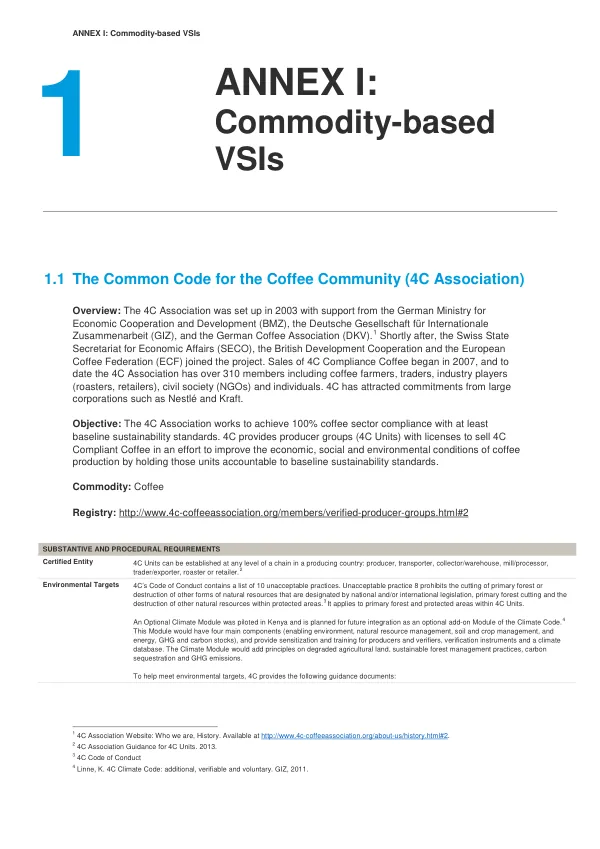
The Common Code for the Coffee Community (4C Association) was established in 2003 with the support of the German Ministry for Economic Cooperation and Development (BMZ), the Deutsche Gesellschaft für Internationale Zusammenarbeit (GIZ), and the German Coffee Association (DKV).
2015 · 74 pages
Sign in to readA free account is required to download.
Abstract
The Swiss State Secretariat for Economic Affairs (SECO), the British Development Cooperation, and the European Coffee Federation (ECF) also joined the project. The 4C Association has over 310 members, including coffee farmers, traders, roasters, retailers, civil society, and individuals. Major corporations such as Nestlé and Kraft have committed to the 4C Association. The primary objective of the 4C Association is to achieve 100% coffee sector compliance with at least baseline sustainability standards. The organization provides licenses to 4C Units, which are producer groups that sell 4C Compliant Coffee. The goal is to improve the economic, social, and environmental conditions of coffee production by holding these units accountable to baseline sustainability standards. The 4C Code of Conduct outlines the criteria for a 4C Unit to receive a green, yellow, or red classification of each principle. The code prohibits the cutting of primary forest or destruction of other forms of natural resources designated by national and/or international legislation. The 4C Climate Module, which is planned for integration as an optional add-on Module of the Climate Code, aims to address climate change and its impacts on coffee production. To achieve compliance, 4C Units must meet specific requirements, including the creation of farm maps, biodiversity conservation plans, and soil analysis. Self-assessments and verifications require documentation of these requirements, and the 4C Secretariat compiles and shares this data with all members and posts it to the 4C website. The 4C Association has a verification process that involves an initial self-assessment, followed by verification by a 4C-approved third-party verifier. The verification report must be kept by the Managing Entity, the verifier, and the 4C Secretariat for a minimum of 6 years. The verification cycle is 3 years, with at least one verification visit in the harvest season. The 4C Secretariat reports the status of the program by circulating a list of licensed 4C Units to members on a regular basis. Members are also provided with updates on any cases of withdrawn licenses or withdrawals. The 4C Association has a strong focus on transparency and accountability, with a goal of achieving 100% coffee sector compliance with baseline sustainability standards. The Aquaculture Stewardship Council (ASC) is another organization that aims to promote responsible farmed seafood. Co-founded by the Sustainable Trade Initiative (IDB) and WWF in 2010, the ASC is associated with market demand and its strengths in social and environmental issues. The ASC has a similar structure to the 4C Association, with a focus on verification and certification of aquaculture practices. Both the 4C Association and the ASC have a strong focus on transparency and accountability, with a goal of promoting sustainable practices in their respective industries.