COASTAL RESOURCES CENTER
Communications Strategy for Sustainable Fisheries Management Project
The USAID/Ghana Sustainable Fisheries Management Project (SFMP) is a five-year initiative aimed at rebuilding marine fisheries stocks and catches through the adoption of responsible fishing practices.
2015 · 51 pages
Sign in to readA free account is required to download.
Abstract
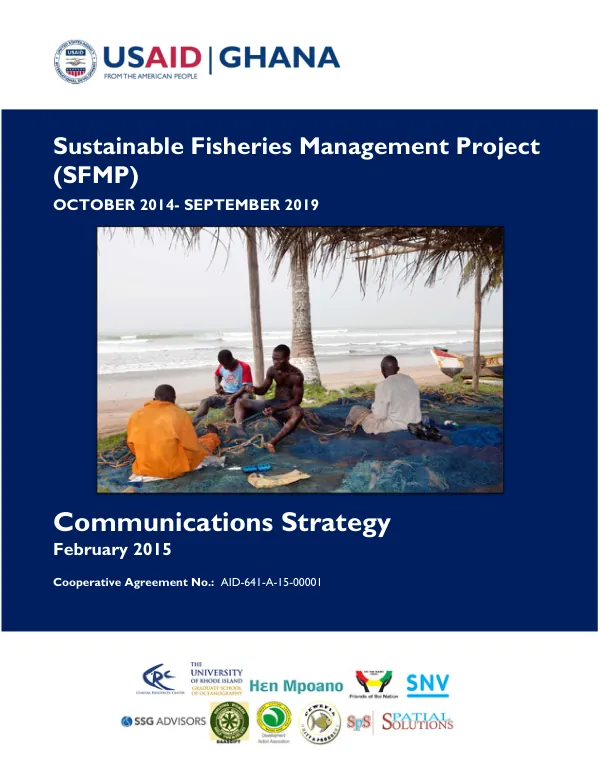
The project, which began in October 2014 and concluded in September 2019, received approximately $24 million in funding from the United States Agency for International Development (USAID). The ultimate objective of the SFMP is to ensure that there are more fish in the waters of Ghana five years hence than there are today, with the goal of sustaining healthy and robust fisheries and promoting the well-being of the people whose survival relies on it. The project focuses primarily on the small pelagic fish stocks, which are crucial for food security in Ghana. This sector supports 100,000 canoe fishers and 20,000 fishmongers and processors. However, small pelagic fish stocks are at near collapse, with annual yields down from approximately 130,000 MT a decade ago to approximately 30,000 MT now. The decline is attributed to fleet overcapacity resulting in overfishing, poor governance, and the open-access nature of the fishery. To address this issue, the SFMP aims to promote the adoption of sustainable fishing practices and reduced exploitation to end overfishing. The project contributes to the Government of Ghana's National Fisheries policies and Development Plans, as well as the Development Objective (DO2) of USAID's Feed the Future (FtF) Initiative of food security and poverty reduction. The SFMP is designed to build on the gains and lessons learned from previous initiatives, with the goal of increasing wild-caught local marine food fish supply and bringing greater profitability to the fishery. This achievement could benefit over 130,000 people directly and up to two million indirectly. The project is led by the Coastal Resources Center at the University of Rhode Island in collaboration with a consortium of partners. The SFMP aims to rebuild marine fisheries stocks and catches through the adoption of responsible fishing practices, contributing to USAID's Feed the Future (FtF) food security, climate change, and biodiversity goals. The project's success will depend on the effective implementation of its strategies, including the development of a national communications strategy to promote the adoption of sustainable fishing practices and reduce exploitation. The national communications strategy for the SFMP is designed to promote the adoption of sustainable fishing practices and reduce exploitation. The strategy focuses on corporate/internal communications, external stakeholder communications, and knowledge management and learning. The project aims to engage with various stakeholders, including policy makers, national level policy campaigns, child labor communications, legislative reforms, and fisheries managers. The strategy also includes a monitoring and evaluation plan to track progress and make adjustments as needed. The SFMP's communications strategy is designed to promote the adoption of sustainable fishing practices and reduce exploitation. The strategy includes a range of activities, such as developing a communications plan, creating a brand identity, and implementing a knowledge management and learning plan. The project also aims to engage with various stakeholders, including policy makers, national level policy campaigns, child labor communications, legislative reforms, and fisheries managers. The project's knowledge management and learning plan is designed to promote the adoption of sustainable fishing practices and reduce exploitation. The plan includes a range of activities, such as developing a communication plan, creating a brand identity, and implementing a knowledge management and learning plan. The project also aims to engage with various stakeholders, including policy makers, national level policy campaigns, child labor communications, legislative reforms, and fisheries managers.
Related documents