USAID DEC
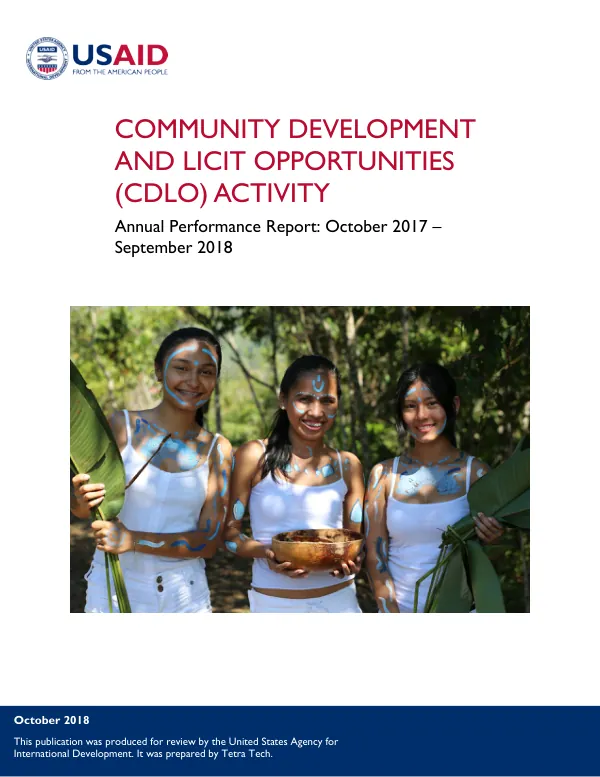
Community Development and Licit Opportunities (CDLO) Activity Annual Performance Report: October 2017 – September 2018
Sign inTETRA TECH
Community Development and Licit Opportunities (CDLO) Activity Annual Performance Report: October 2017 – September 2018
The Community Development and Licit Opportunities Activity (CDLO) is a program aimed at promoting collective vision of territorial alternative and rural development in Colombia.
2018 · 52 pages
Sign in to readA free account is required to download.
Abstract
The program's main objective is to empower rural citizens to function as effective partners with the public and private sectors. CDLO's senior technical staff and field personnel continuously evaluate and fine-tune the program's overall strategy for sustainable territorial development. Throughout Fiscal Year 2018, CDLO implemented various interventions to achieve its objectives. The program focused on three key areas: regional status, detailed list of approved activities, and status of overall activity progress. CDLO's regional offices and staffing were established to support the program's implementation. The program also conducted a mapping and characterization of corridors exercise to identify areas of high illicit crop production. CDLO continued to collaborate with relevant stakeholders, including the Government of Colombia, community-based organizations, and local solution partners. The program's budget for Fiscal Year 2018 was allocated to support the implementation of approved activities. CDLO's annual spending for Fiscal Year 2018 totaled $X, with contractual instruments in place to ensure the program's progress. The program's progress was impacted by two significant events: the transition of the Government of Colombia and the release of the 2017 United Nations Office on Drugs and Crime report, which showed a 17% increase in coca cultivation. These events led to a more aggressive policy stance against coca cultivation and large-scale opposition from rural populations, hampering CDLO efforts in high illicit crop production areas. Despite these challenges, CDLO continued to make progress towards its objectives. The program's senior technical staff and field personnel evaluated and fine-tuned the program's overall strategy for sustainable territorial development. Strategic adjustments were made to incorporate lessons learned from previous interventions, detailed territorial mapping, baseline studies, and careful analysis of territorial security considerations. CDLO's interventions focused on promoting a collective vision of territorial alternative and rural development. The program empowered rural citizens to function as effective partners with the public and private sectors. CDLO's progress was monitored and evaluated through various indicators, including the status of required audit processes, the use of U.S. small and disadvantaged business, and projected USAID approvals, waivers, or deviation requests. The program's budget was allocated to support the implementation of approved activities, with a total annual spending of $X. CDLO's contractual instruments were in place to ensure the program's progress. The program's senior technical staff and field personnel continuously evaluated and fine-tuned the program's overall strategy for sustainable territorial development. CDLO's progress was impacted by the growing presence of organized crime groups in at least 10 departments, including Antioquia, Bajo Cauca, Córdoba, Cundinamarca, Norte de Santander, Valle del Cauca, Nariño, Cauca, Meta, Guaviare, and Vichada. Seven of these departments fall under CDLO's coverage, and these developments augur an uptick in violence in areas already suffering from lack of citizen security.
Related documents