USAID
Community Forests Program (CFP) in Zambia
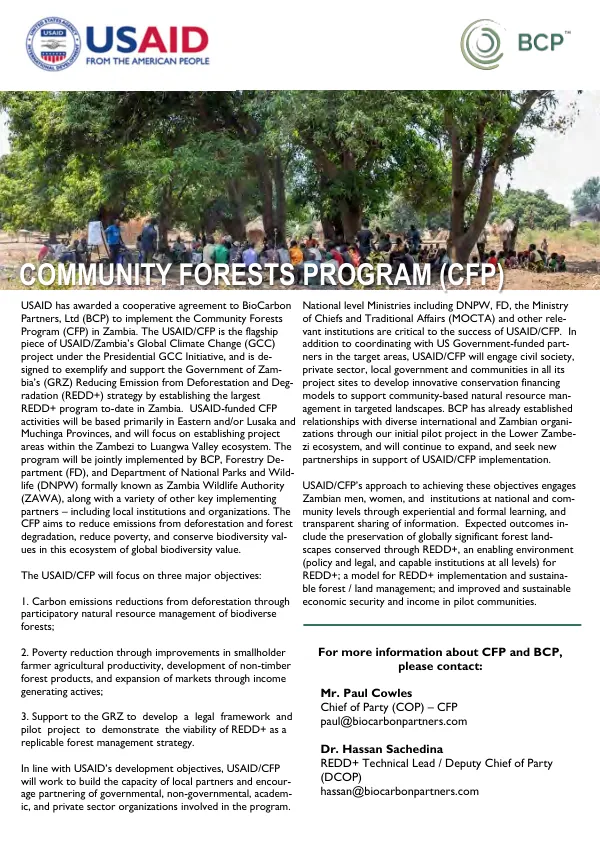
The Community Forests Program (CFP) in Zambia aims to reduce emissions from deforestation and forest degradation, reduce poverty, and conserve biodiversity values in the Zambezi to Luangwa Valley ecosystem.
2017 · 1 pages
Sign in to readA free account is required to download.
Abstract
The program is a flagship piece of USAID/Zambia's Global Climate Change (GCC) project, designed to support the Government of Zambia's (GRZ) Reducing Emission from Deforestation and Degradation (REDD+) strategy. The CFP will be implemented in Eastern and/or Lusaka and Muchinga Provinces, with a focus on establishing project areas within the Zambezi to Luangwa Valley ecosystem. The program will be jointly implemented by BioCarbon Partners, Ltd (BCP), the Forestry Department (FD), the Department of National Parks and Wildlife (DNPW), and other key implementing partners, including local institutions and organizations. The CFP has three major objectives: reducing carbon emissions from deforestation through participatory natural resource management of biodiverse forests, reducing poverty through improvements in smallholder farmer agricultural productivity and development of non-timber forest products, and supporting the GRZ to develop a legal framework and pilot project to demonstrate the viability of REDD+ as a replicable forest management strategy. In line with USAID's development objectives, the CFP will work to build the capacity of local partners and encourage partnering of governmental, non-governmental, academic, and private sector organizations involved in the program. National level Ministries, including DNPW, FD, the Ministry of Chiefs and Traditional Affairs (MOCTA), and other relevant institutions, are critical to the success of the CFP. The program will engage civil society, private sector, local government, and communities in all project sites to develop innovative conservation financing models to support community-based natural resource management in targeted landscapes. The CFP's approach to achieving its objectives engages Zambian men, women, and institutions at national and community levels through experiential and formal learning, and transparent sharing of information. Expected outcomes include the preservation of globally significant forest landscapes conserved through REDD+, an enabling environment for REDD+, a model for REDD+ implementation and sustainable forest/land management, and improved and sustainable economic security and income in pilot communities. The program will be led by Mr. Paul Cowles, Chief of Party (COP), and Dr. Hassan Sachedina, REDD+ Technical Lead/Deputy Chief of Party (DCOP).
Related documents