USAID DEC
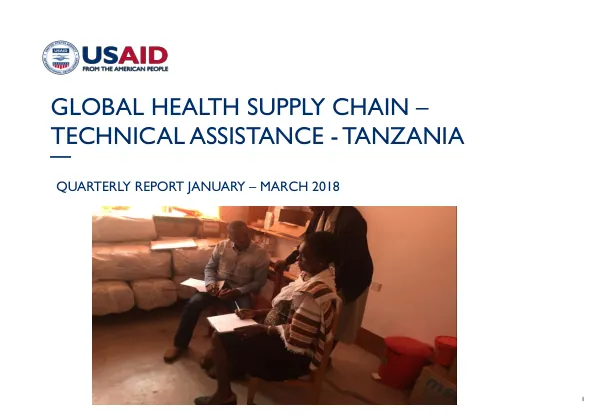
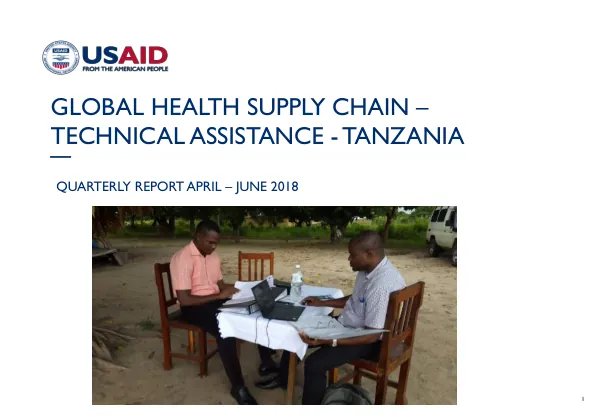
GLOBAL HEALTH SUPPLY CHAIN – TECHNICAL ASSISTANCE - TANZANIA QUARTERLY REPORT APRIL – JUNE 2018
Sign inTANZANIAN MINISTRY OF HEALTH, COMMUNITY DEVELOPMENT, GENDER, ELDERLY AND CHILDREN’S
GLOBAL HEALTH SUPPLY CHAIN – TECHNICAL ASSISTANCE - TANZANIA QUARTERLY REPORT APRIL – JUNE 2018
The Global Health Supply Chain - Technical Assistance - Tanzania project aims to support the development of agile, robust, and sustainable health supply chains that contribute to improving medicines availability and the health status of Tanzanians.
2018 · 58 pages
Sign in to readA free account is required to download.
Abstract
The project's goal is to align stakeholders on national supply chain objectives, harmonize strategic documents with supply chain goals, and hold stakeholders accountable for their contributions towards strategic plans. The project focuses on four key work streams: strategic planning and implementation assistance, supply chain costing and financing strategies, management information systems, and logistics management unit. The project works closely with key stakeholders, including the Ministry of Health, Community Development, Gender, Elderly and Children (MOHCDGEC), the Pharmaceutical Services Unit (PSU), vertical programs, Medical Stores Department (MSD), and President's Office of Regional Administration and Local Governments (PO-RALG). During the period of April to June 2018, the project's focus was on finalizing national health supply KPIs, incorporating holistic supply chain review recommendations into the National Pharmaceutical Policy and Action Plan (NPAP), and developing a dashboard to monitor supply chain performance. The project supported the PSU to revise the Holistic Supply Chain Review (HSCR) Costed Implementation Plan (CIP) and submitted it for approval. The project also drafted the supply chain standardized KPI Reference Manual and submitted it to PSU for endorsement. The project also promoted deliberate and routine integration of costing and financing components into supply chain interventions and activities, and alignment of stakeholders around the cost of the supply chain and available funding sources. The project completed the data analysis and report writing for the assessment to estimate the total health commodity financial needs at primary health care facilities, the amount of available funds to cover those needs, and the financial gap. The project's accomplishments during the quarter include finalizing the national standardized supply chain KPIs and reference manual, revising the HSCR CIP, and drafting the supply chain standardized KPI Reference Manual. The project also conducted a range of activities, including on-the-job training for healthcare workers, training for PORALG staff, and technical assistance on national ARVs and HIV and related lab quantification. The project's deliverables for the quarter include the national standardized supply chain KPIs and reference manual, the supply chain dashboard for monitoring ZSCAP, and the final report on the total health commodities financial needs assessment. The project's activities for the quarter four include finalizing the development of the dashboard for monitoring implementation of ZSCAP and alignment of NPAP to incorporate HSCR recommendations, conducting a national baseline survey for KPI, and finalizing the mapping of different sources of funding for health supply chain. The project's geographic focus is mainland Tanzania and Zanzibar, with a total of around 7,000 public sector health facilities. The project's timeframe is from June 2016 to June 2021, with a 3-year base and 2-year option years. The project's goal is to support the development of agile, robust, and sustainable health supply chains that contribute to improving medicines availability and the health status of Tanzanians.