CLINTON HEALTHCARE ACCESS INITIATIVE
Community Health Worker Incentives: Lessons Learned and Best Practices from Malawi
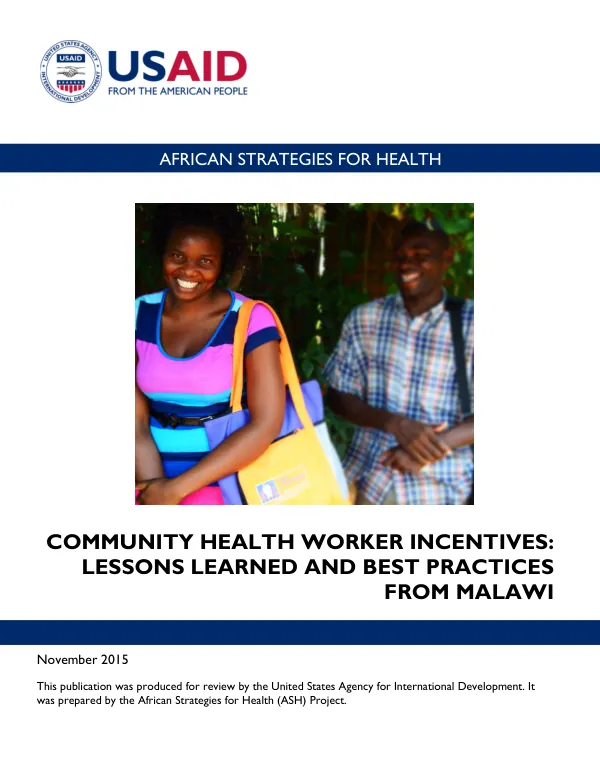
Community Health Worker Incentives: Lessons Learned and Best Practices from Malawi began in 2015 with the objective of identifying effective incentives for community health workers (CHWs) in Malawi.
2015 · 66 pages
Sign in to readA free account is required to download.
Abstract
The study was conducted by Management Sciences for Health (MSH) under the African Strategies for Health (ASH) project, with support from the US Agency for International Development (USAID). Malawi's Ministry of Health (MOH) has been implementing various CHW programs, including Health Surveillance Assistants (HSAs), Inter-personal Communication Agents (IPCAs), Community-based Distribution Agents (CBDA), and Volunteer Programs. These programs aim to improve health outcomes, particularly in rural areas where access to healthcare services is limited. The study sampled five districts in Malawi, including Salima, Mangochi, Machinga, Kasungu, and Mchinji. Data collection involved interviews with CHWs, facility-in-charge staff, and village health committee members. The study also reviewed existing literature on CHW incentives and programs in Malawi. Financial incentives were identified as a key motivator for CHWs in Malawi. Salaries, per diems for trainings and meetings, and the sale of medicines and health commodities were found to be effective incentives. Income-generating activities, such as farming and small-scale business ventures, were also identified as potential incentives. Performance-based incentives, such as bonuses for meeting targets, were also explored. Nonfinancial incentives, including recognition, social status, and community support, were also found to be important motivators for CHWs. CHWs reported that recognition from their communities and the MOH was a significant incentive, as it boosted their morale and motivation. Social status, particularly among women, was also found to be an important incentive, as it helped to improve their reputation and standing in their communities. The study found that CHWs in Malawi face various challenges, including limited resources, inadequate training, and lack of recognition. However, the study also identified several best practices, including the use of financial and nonfinancial incentives, regular training and supervision, and community-based approaches to health service delivery. The study's findings have implications for policy and program development in Malawi and other countries. The study recommends that governments and development partners prioritize the use of incentives, particularly financial incentives, to motivate CHWs. The study also recommends that CHWs be recognized and valued for their contributions to health service delivery, and that their roles and responsibilities be clearly defined and supported. The study's methodology involved a mixed-methods approach, combining both qualitative and quantitative data collection and analysis methods. The study's results are based on data collected from five districts in Malawi, and the study's findings are intended to inform policy and program development in Malawi and other countries. The study's authors acknowledge the contributions of various individuals and organizations, including the MOH, nongovernmental organizations, and community health workers. The study's authors also acknowledge the support of USAID and the ASH project, which funded the study. The study's results are presented in a clear and concise manner, with tables and figures used to illustrate key findings. The study's executive summary provides an overview of the study's objectives, methodology, and findings, and is intended to provide a brief summary of the study's main results. The study's background section provides an overview of the context in which the study was conducted, including the objectives, defining CHWs, and measuring CHW performance. The study's country context section provides an overview of Malawi's health system and the role of CHWs in improving health outcomes. The study's study methodology section provides an overview of the data collection and analysis methods used in the study. The study's results section presents the study's findings, including the use of financial and nonfinancial incentives, regular training and supervision, and community-based approaches to health service delivery. The study's summary of findings section provides an overview of the study's main results, including the use of financial and nonfinancial incentives, regular training and supervision, and community-based approaches to health service delivery. The study's conclusions section provides an overview of the study's main findings and recommendations. The study's acronyms section provides a list of acronyms used in the study, including ASH, BLM, CAG, CBDA, CHAI, CHAM, CHBC, CHV, CHW, DHO, DRH, EHRP, HSA, iCCM, IEC, IMCI, IPCA, MOH, MSPA, MSH, NAMPAM, NGO, PLHIV, PSI, REACH, STI, TB, TBA, IUD, VHC, and WHO. The study's contents section provides an overview of the study's structure and organization, including the executive summary, background, country context, study methodology, results, summary of findings, conclusions, acronyms, list of tables, and list of figures.