USAID
Tool to Estimate Patients’ Costs
Wealth and income are theoretically different concepts with different concepts with different aspects of policymaking.
2009 · 3 pages
Sign in to readA free account is required to download.
Abstract
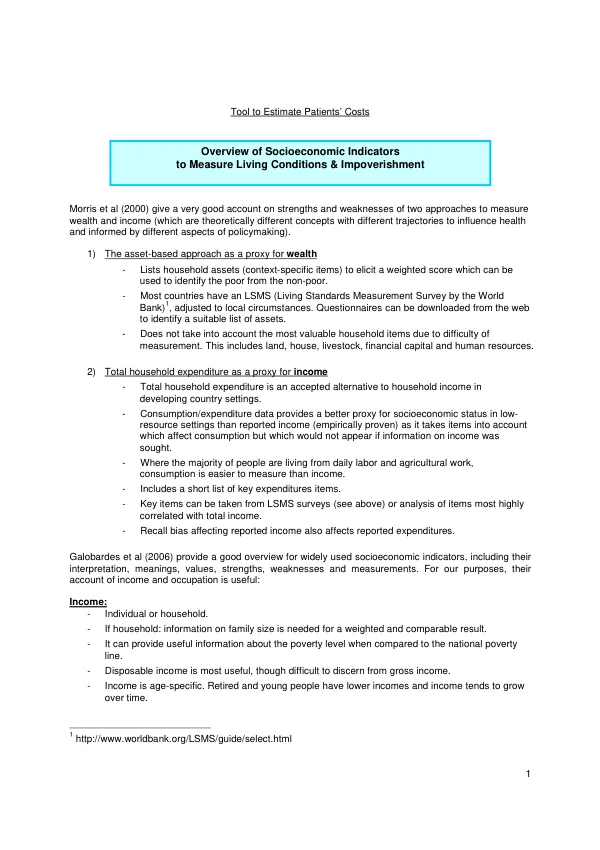
The asset-based approach as a proxy for wealth measures household assets to elicit a weighted score, which can be used to identify the poor from the non-poor. Most countries have an MSLS, adjusted to local context, which can be used to create a suitable list of assets. However, this approach does not account for the most valuable household items due to difficulty of measurement, including land, house, livestock, financial assets, and human resources. Total household expenditure is an alternative proxy for income in developing country settings. Consumption/expenditure data provides a better socioeconomic status in low-resource settings than reported income, as it takes into account items that affect consumption but not income. In settings where people live from daily work and agricultural work, consumption is easier to measure than income. A short list of key expenditure items can be taken from MSLS surveys or analysis of items most correlated with total income. However, reported income and expenditures are subject to recall bias. Income is a useful indicator of socioeconomic status, providing information about the poverty level when compared to the national poverty line. However, it is difficult to discern from gross income, and individual or household income is age-specific, with retired and young people having lower incomes. Income tends to grow over time. Household income is most useful, but family size needs to be considered for a weighted and comparable result. Occupation provides information about social status and related income, as well as writing conditions and hazards. However, it is not useful for individuals with informal or household work, the unemployed, students, or students. Different kinds of poverty exist, including poverty among migrants, single mothers, refugees, the unemployed, slum dwellers, and rural farmers, each with different socioeconomic characteristics. A set of widely used indicators has been empirically shown to capture socioeconomic status among poverty sub-groups, including literacy, education, place of residence, work status, type of employment, occupation, type of work, schooling of children, income, food availability, and housing conditions, housing conditions, household amenities, assets, health insurance, land ownership, productive assets, school-aged children working, adult man in household, occupation of household head, clothing, social involvement, and cooking fuel source. These indicators can serve as a checklist for questionnaires stratifying individuals according to socioeconomic status. Their interpretation is context-specific, though some indicators are used globally and have been proven and popular measures to assess socioeconomic status. The literature sources below provide information on the correct interpretation and usage of socioeconomic indicators, which can guide the adaptation of the generic questionnaire to local circumstances and the interpretation of survey results. Household consumption on food and non-food items, as well as individual and household reported income, are useful to include for reasons given above. However, asset-based approaches are useful but context-specific. If assets are included, questionnaires need to be adapted to local circumstances, which can be done by using data/questions from World Bank LSMS studies. Information on assets can be collected through interviews away from the patient's home, but it is better to assess them directly in the patient's home. The literature on poverty measurement has identified different approaches to identify the poor, including the asset-based approach, total household expenditure, and individual and household reported income. These approaches have different strengths and weaknesses, and their usage depends on the context and the context-specific indicators. The widely used indicators of socioeconomic status include literacy, education, place of residence, work status, type of employment, occupation, type of work, schooling of children, income, food availability, and housing conditions, housing conditions, household amenities, assets, health insurance, land ownership, productive assets, school-aged children working, adult man in household, occupation of household head, clothing, social involvement, and cooking fuel source. These indicators can serve as a checklist for questionnaires stratifying individuals according to socioeconomic status.