GOVERNMENT OF COLOMBIA
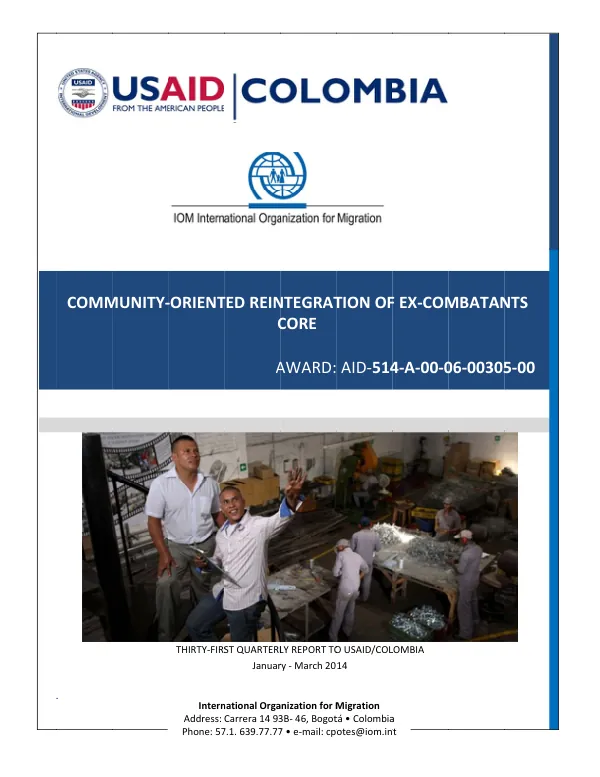
Community-Oriented Reintegration of Ex-Combatants - CORE
The Community-Oriented Reintegration of Ex-combatants (CORE) program in Colombia is a USAID-funded initiative aimed at supporting the reintegration of ex-combatants into society.
2014 · 50 pages
Sign in to readA free account is required to download.
Abstract
The program is implemented in partnership with the Colombian Government and other stakeholders. The program's objective is to support the implementation of laws related to the reintegration and legal status of ex-combatants. The program's activities are focused on several key areas, including the development of tools and methodologies to support the implementation of the Justice and Peace Law. The program also provides technical support to assess psychosocial readiness for reintegration through the IECC (Graduation Competencies Evaluation Instrument). In the quarter from October 1 to December 31, 2013, 1,906 surveys were conducted, and 52% of the participants fulfilled the requisites of the instruments required by the ACR (Colombian Reintegration Agency) to continue with the graduation process. The program also implemented the "Integrated Employment Intervention Route," which aims to support demobilized individuals in exploring and finding opportunities in the job market. The ACR and CORE worked together to develop three job placement projects in seven departments to benefit 475 demobilized individuals in the process of reintegration. Project results this quarter included the initiation of implementation of the toolkit in several departments, engagement with 76 businesses, referral of 734 people in the process of reintegration to vacancies, and hiring of 224 people in the process of reintegration. In addition, the program continued to support the various sub-units of the Justice and Peace Unit in the Attorney General's office. These activities focused on land restitution, facilitating sentencing in high-priority cases, strengthening the ACR's capacity to identify and return human remains to victims' families, complementing the construction of patterns of macro-criminality with similar investigations of macro-victimization, and strengthening regional work in the sub-units. Results this quarter included analysis of 628 cases related to usurping of land, creation of 7 reports on macro-criminality and land usurpation, registration of 39 genetic profiles in the CODIS software, analysis of 145 DNA samples, and compilation of 3,000 kits to identify and take DNA samples. The program also continued to work on the Inter-institutional Information System for Justice and Peace, or SIIJYP, Phase II. The system aims to provide a comprehensive database of information on victims, perpetrators, and cases related to the Justice and Peace Law. The program's financial report for the quarter shows a total expenditure of $X, with a balance of $Y remaining in the budget. The program's priorities for the next quarter include continuing to support the implementation of the Justice and Peace Law, expanding the "Integrated Employment Intervention Route" to reach more demobilized individuals, and strengthening the ACR's capacity to identify and return human remains to victims' families. The program will also continue to work on the SIIJYP Phase II and other ongoing projects.
Related documents