USAID DEC
Disengaged Children and Adolescents in Colombia: Report on Forced Recruitment and Reintegration
Sign inGOVERNMENT OF COLOMBIA
Disengaged Children and Adolescents in Colombia: Report on Forced Recruitment and Reintegration
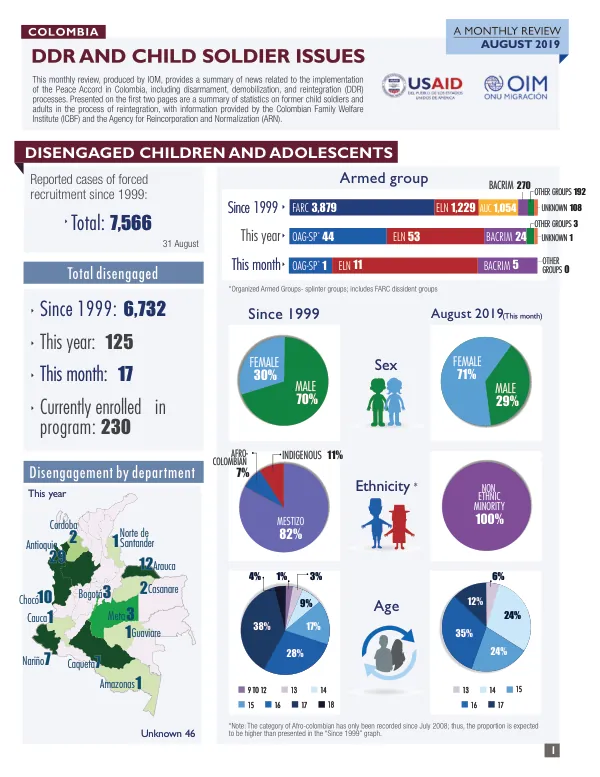
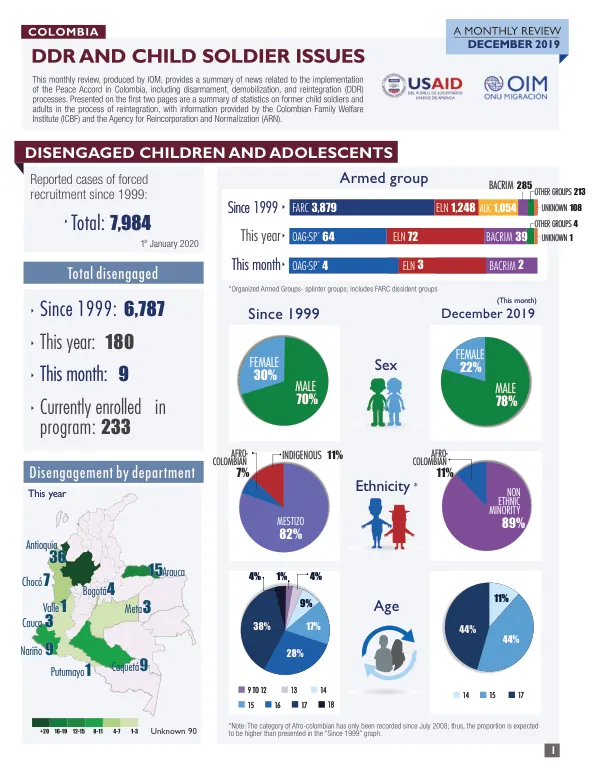
DISENGAGED CHILDREN AND ADOLESCENTS The total number of disengaged children and adolescents since 1999 is 7,984.
2020 · 4 pages
Sign in to readA free account is required to download.
Abstract
Of these, 82% are Mestizo, 78% are male, and 22% are female. The majority of disengaged children and adolescents, 64%, are affiliated with the FARC, followed by 39% with BACRIM, and 12% with ELN. Implementation of the Peace Accord has led to the enrollment of 233 disengaged children and adolescents in a program aimed at their reintegration into civilian life. The program focuses on providing education, economic opportunities, and social support to help them reintegrate into their communities. The majority of disengaged children and adolescents, 87%, are male, and 13% are female. The age range of disengaged children and adolescents is diverse, with 46% between 18 and 25 years old, 36% between 26 and 35 years old, and 10% under 18 years old. Geographically, the disengaged children and adolescents are distributed across various departments in Colombia, with the highest numbers in Antioquia, Meta, and Caquetá. The current occupation of disengaged children and adolescents varies, with 48% employed in the informal sector, 22% employed in the formal sector, and 9% unemployed. ADULTS IN REINTEGRATION PROCESS The total number of adults in the reintegration process since 1999 is 61,653. Of these, 87% are male, and 13% are female. The majority of adults in the reintegration process, 53%, are part of a collective demobilization, while 47% are part of an individual demobilization. The age range of adults in the reintegration process is diverse, with 46% between 18 and 25 years old, 36% between 26 and 35 years old, and 10% under 18 years old. The majority of adults in the reintegration process, 63%, are male, and 37% are female. Geographically, the adults in the reintegration process are distributed across various departments in Colombia, with the highest numbers in Valle, Chocó, and Risaralda. The current state of all participants in the reintegration process is diverse, with 41% formally removed, 28% successfully completed, and 11% in process. KEY DEVELOPMENTS The implementation of the Peace Accord has faced several challenges, including the murder of 110 social leaders this year and the killing of at least 77 former FARC combatants. The Government has presented a new roadmap for the reintegration of former FARC combatants into civilian life, which includes seven milestones that each individual combatant must meet. The Special Jurisdiction for Peace (JEP) has announced that it will start looking for a mass grave in the cemetery of Dabeiba, believed to contain the remains of 50 victims of "false positives" killed by the army. The Ministry of Defense has declared its willingness to cooperate with the JEP in the search for truth, justice, reparation, and non-repetition. The Government and the FARC have conducted an evaluation of the land acquisition possibilities and strategic locations of the 24 former Territorial Spaces for Training and Reincorporation (ETCR). It was decided that five of them will be relocated, including those in Ituango, Puerto Asís, La Macarena, Tumaco, and San José del Guaviare. The High Commissioner for Peace, Miguel Ceballos, has declared his openness to dialogue with the ELN, but with conditions, including the return of kidnapped people and the cessation of criminal activities. The JEP is investigating a new "false positives" case in Dabeiba. The global launch of the Human Development Report 2019 took place on 9 December in Bogotá, highlighting the link between inequality and conflict. The report argues that inequality can be seen as a cause of conflict, while conflict can create extreme inequality.
Related documents