USAID DEC
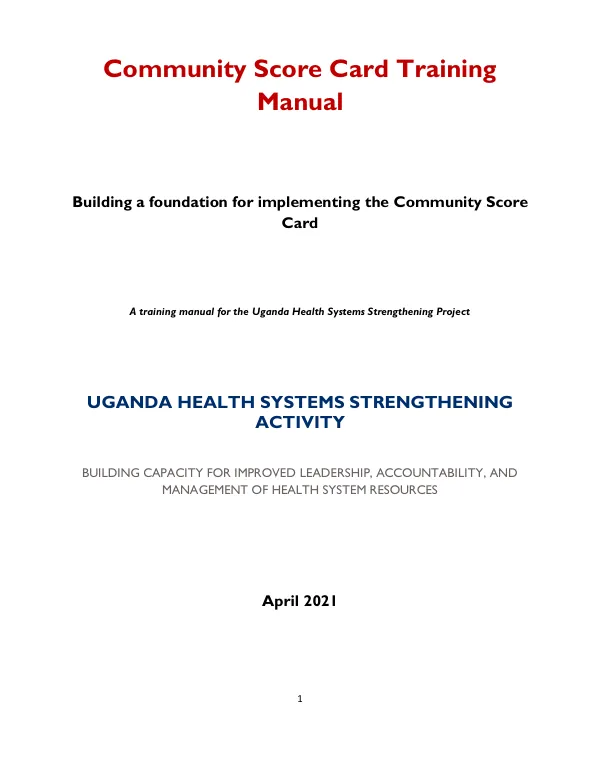
Community Scorecard Training Manual: Building a foundation for implementing the Community Score Card
Sign inUSAID
Community Scorecard Training Manual: Building a foundation for implementing the Community Score Card
Health service delivery in Uganda is constrained by a highly fragmented and under-resourced health system, weak leadership and accountability systems, dependency on external funding, and poorly functioning community health systems.
2021 · 50 pages
Sign in to readA free account is required to download.
Abstract
The U.S. Agency for International Development (USAID) Uganda Health Systems Strengthening (UHSS) Activity aims to address these chronic health systems constraints by strengthening leadership and accountability for results across all levels of the health system; increasing availability and management of key health systems resources, including human resources for health; and strengthening community systems for quality health services. The Community Score Card is a tool used to enable citizens to contribute to the efficiency and effectiveness of healthcare interventions. Citizens are empowered to articulate and demand their rights and meaningfully engage with service providers to improve management of public resources and delivery of health services. The Community Score Card process involves monitoring the activities of duty bearers to ensure that they happen as planned, deliver the desired goods, and the intended beneficiaries receive the services in time with participation of the target groups. Access to quality healthcare is a right which requires right holders to demand entitlements and duty bearers to fulfil their obligations. Citizens are at both ends of the equation, as right holders who should demand for health policies and programs that are responsive to their needs and priorities, and as duty bearers with an obligation to take necessary actions to prevent ill health and death and seek healthcare. It is both a right and a duty for citizens to use constitutional means to influence healthcare delivery in their favour. The Community Score Card process involves several key components, including monitoring, community monitoring, and social accountability. Monitoring refers to the process of systematic tracking of activities of various duty bearers to ensure that they happen as planned, deliver the desired goods, and the intended beneficiaries receive the services in time with participation of the target groups. Community monitoring, or social accountability, is a form of public oversight, ideally driven by local information needs and community values, to increase the accountability and quality of social services. The UHSS Activity aims to strengthen leadership and accountability for results across all levels of the health system, increase availability and management of key health systems resources, including human resources for health, and strengthen community systems for quality health services. The training manual for the Community Score Card is based on adult learning theory and uses educational presentations sparingly and small group exercises liberally. The six units of the manual introduce and explain the concept of the topics covered, ranging from Health Rights and Responsibilities, entitlements at each level of health service delivery, Feedback and redress Mechanisms at Health service points, Community Score Cards methodology and application. The training manual is designed to equip trainers with knowledge and skills on how to effectively implement the Community Score Card. The overall goal of the training is to equip the trainers with knowledge and skills on how to effectively implement the Community Score Card. The objectives of the training are to demonstrate skills needed to plan and conduct the training programme at the next level, and to equip the trainers with knowledge and skills on how to effectively implement the Community Score Card. The training is expected to last for 3 days and will cover the following topics: Climate setting, Health Rights and Responsibilities, entitlements at each level of health service delivery, Feedback and redress Mechanisms at Health service points, Community Score Cards methodology and application, and Participatory Monitoring. The trainer is expected to follow the order in the manual if he/she is to achieve the objectives of the training. A pre and post training evaluation will be conducted by the trainer.