MINISTRY OF HEALTH
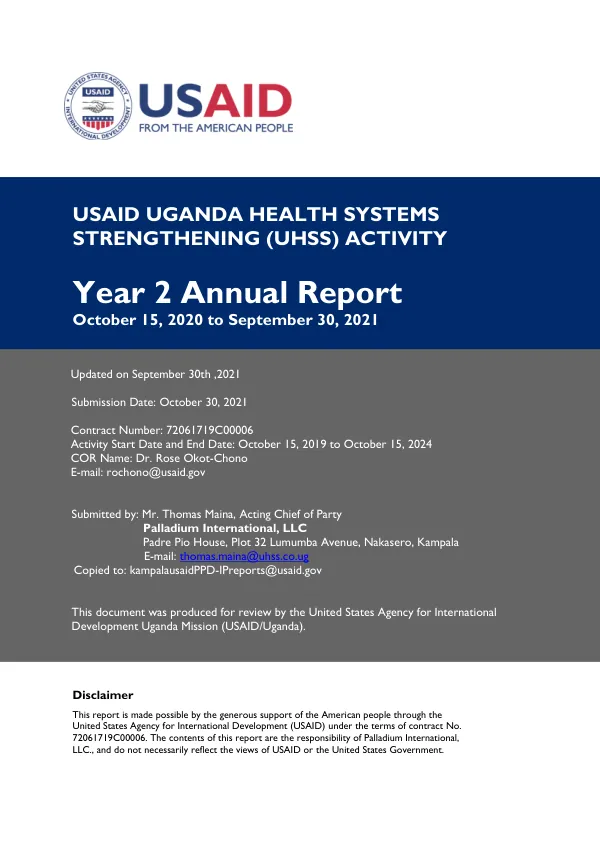
USAID UGANDA HEALTH SYSTEMS STRENGTHENING (UHSS) ACTIVITY ANNUAL REPORT FOR PY2
The United States Agency for International Development (USAID) Uganda Health Systems Strengthening (UHSS) Activity is an above-site health system strengthening activity whose goal is to improve the performance of Uganda's health systems through technical assistance (TA).
2021 · 75 pages
Sign in to readA free account is required to download.
Abstract
The activity is implemented by Palladium International, LLC, and is funded by USAID under the terms of contract No. 72061719C00006. The activity aims to strengthen the health systems in Uganda by improving governance, leadership, and accountability for results. The activity focuses on five thematic domains: governance, leadership, and accountability; health financing; health workforce; health information systems; and health commodity security. The activity is implemented in 99 districts across Uganda, with a focus on improving the performance of the health systems in these districts. The activity is expected to improve the health outcomes in Uganda by strengthening the health systems and improving the access to quality health services. The activity has made significant progress in the second year of implementation, with a focus on improving the governance, leadership, and accountability for results. The activity has trained over 1,000 leaders in governance, leadership, and accountability, and has established a performance management dashboard to track the progress of the activity. The activity has also made significant progress in improving the health financing, with a focus on increasing the absorption of government funds for key programs under the Results-Based Financing (RBF) approach. The activity has also made significant progress in improving the health workforce, with a focus on increasing the availability and management of key health systems resources. The activity has trained over 500 health workers in integrated community case management (iCCM) and has established a community health workforce registry to track the progress of the activity. The activity has also made significant progress in improving the health information systems, with a focus on increasing the availability and use of data for decision-making. The activity has also made significant progress in improving the health commodity security, with a focus on increasing the availability and management of key health commodities. The activity has trained over 200 health workers in logistics management and has established a supply chain management system to track the progress of the activity. The activity has also made significant progress in improving the infection prevention and control (IPC) practices, with a focus on reducing the incidence of hospital-acquired infections. The activity has also made significant progress in improving the community systems for quality health services, with a focus on increasing the availability and use of quality health services at the community level. The activity has trained over 1,000 community health workers in integrated community case management (iCCM) and has established a community health workforce registry to track the progress of the activity. The activity has also made significant progress in improving the social and behavior change communication (SBCC) practices, with a focus on increasing the awareness and knowledge of key health issues among the community members. The activity has also made significant progress in implementing the guiding principles, with a focus on increasing the transparency and accountability of the activity. The activity has established a monitoring and evaluation system to track the progress of the activity and has made significant progress in implementing the results-based financing (RBF) approach. The activity has also made significant progress in curbing corruption, both internally and externally, with a focus on increasing the transparency and accountability of the activity. The activity has also made significant progress in environmental compliance, with a focus on increasing the sustainability of the activity. The activity has established an environmental management system to track the progress of the activity and has made significant progress in implementing the environmental policies and procedures. The activity has also made significant progress in knowledge management and communications, with a focus on increasing the awareness and knowledge of key health issues among the stakeholders. The activity has also made significant progress in monitoring, evaluation, and learning, with a focus on increasing the availability and use of data for decision-making. The activity has established a monitoring and evaluation system to track the progress of the activity and has made significant progress in implementing the results-based financing (RBF) approach. The activity has also made significant progress in implementing the guiding principles, with a focus on increasing the transparency and accountability of the activity. The activity has also made significant progress in implementing the COVID-19 emergency response support, with a focus on increasing the availability and use of quality health services during the pandemic. The activity has trained over 1,000 health workers in integrated community case management (iCCM) and has established a community health workforce registry to track the progress of the activity. The activity has also made significant progress in improving the infection prevention and control (IPC) practices, with a focus on reducing the incidence of hospital-acquired infections during the pandemic. The activity has also made significant progress in improving the health outcomes in Uganda, with a focus on increasing the availability and use of quality health services. The activity has trained over 5,000 health workers in integrated community case management (iCCM) and has established a community health workforce registry to track the progress of the activity. The activity has also made significant progress in improving the health financing, with a focus on increasing the absorption of