GLOBAL FUND
Concept Note/Burundi Partnership Framework
The Partnership Framework for Burundi aims to support the Government of Burundi's (GOB) efforts to develop a sustainable response to the HIV/AIDS epidemic.
2011 · 11 pages
Sign in to readA free account is required to download.
Abstract
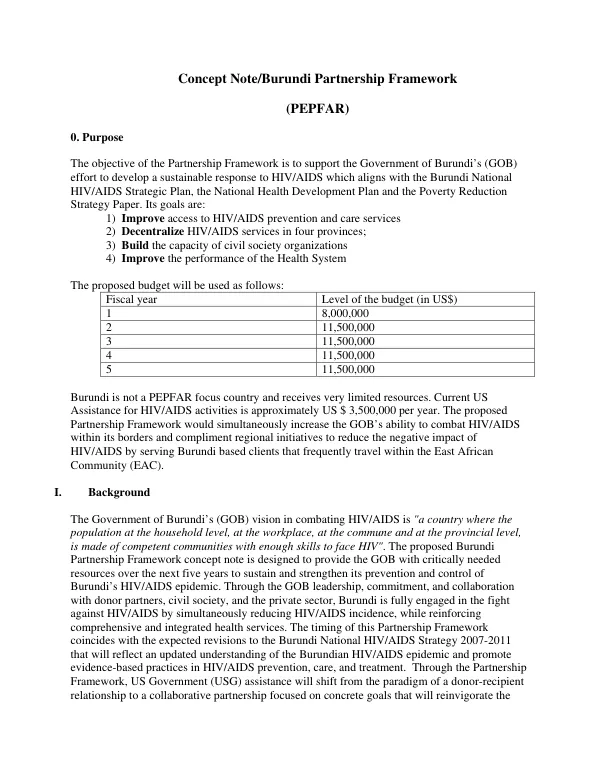
The framework's goals are aligned with the Burundi National HIV/AIDS Strategic Plan, the National Health Development Plan, and the Poverty Reduction Strategy Paper. The primary objectives are to improve access to HIV/AIDS prevention and care services, decentralize HIV/AIDS services in four provinces, build the capacity of civil society organizations, and improve the performance of the Health System. The proposed budget for the Partnership Framework is $8,000,000 for the first fiscal year, increasing to $11,500,000 for each of the subsequent four years. This funding will be used to support the GOB's efforts to combat HIV/AIDS within its borders and complement regional initiatives to reduce the negative impact of the epidemic. Burundi is a low-income developing country with a high HIV/AIDS prevalence rate, particularly in rural areas. The country has made significant improvements in the area of HIV/AIDS, including the creation of voluntary counseling and testing (VCT) sites, the integration of prevention of mother-to-child transmission (PMTCT) in antenatal clinics, and the decentralization of HIV/AIDS services. However, despite these improvements, HIV/AIDS remains a priority public health threat, with a national HIV prevalence of approximately 3% and a significant increase in rural areas. The main challenges and gaps of the National HIV/AIDS Burundi Program include high-risk behaviors among the general population, low rates of condom use, limited availability of VCT, frequent shortages of medicines and lab reagents, limited decentralization of PMTCT services, and insufficient access to post-exposure prophylaxis. The Partnership Framework aims to address these challenges by supporting the GOB's efforts to improve access to HIV/AIDS prevention and care services, build the capacity of civil society organizations, and improve the performance of the Health System. The Partnership Framework will complement the work being implemented by the GOB and other development partners in selected provinces, which are in great need. The proposed geographical provinces and respective prevalence rates are Ngozi (2.56%), Karuzi (4.46%), Ruyigi (3.73%), and Cankuzo (3.57%). The goals of the Partnership Framework concept note are to support the GOB to develop a sustainable response to HIV/AIDS, improve access to HIV/AIDS prevention and care services, decentralize HIV/AIDS services, build the capacity of civil society organizations, and improve the performance of the Health System. The Partnership Framework will support the GOB's efforts to address the main challenges and gaps of the National HIV/AIDS Burundi Program, including high-risk behaviors, low rates of condom use, limited availability of VCT, frequent shortages of medicines and lab reagents, limited decentralization of PMTCT services, and insufficient access to post-exposure prophylaxis. The framework will also support the GOB's efforts to improve the performance of the Health System, including the training of medical personnel and the provision of equipment and supplies. The Partnership Framework will be implemented over a period of five years, with a budget of $8,000,000 for the first fiscal year and $11,500,000 for each of the subsequent four years. The framework will support the GOB's efforts to develop a sustainable response to the HIV/AIDS epidemic, improve access to HIV/AIDS prevention and care services, decentralize HIV/AIDS services, build the capacity of civil society organizations, and improve the performance of the Health System.
Related documents