ACTED
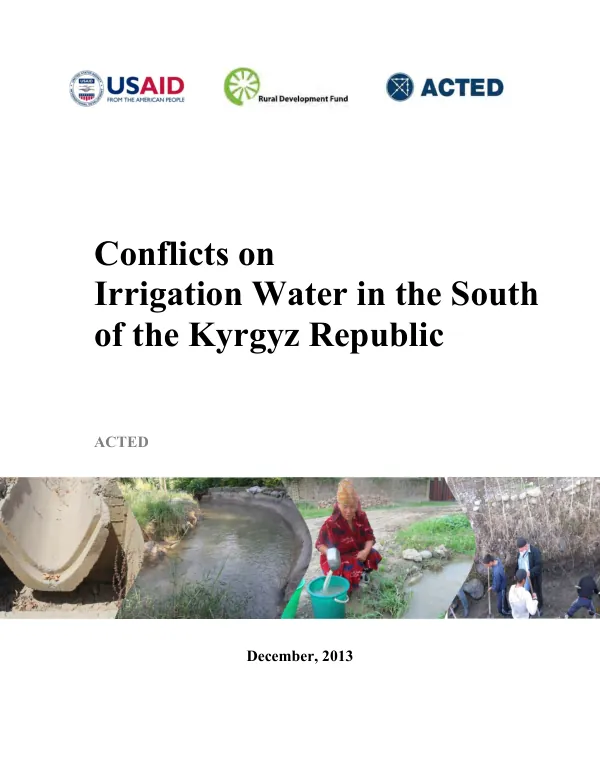
Conflicts on Irrigation Water in the South of the Kyrgyz Republic
The Kyrgyz Republic is a small, mountainous, and landlocked country with more than 65 percent of the population living in rural areas and relying on agriculture for income, subsistence, and food security.
2013 · 52 pages
Sign in to readA free account is required to download.
Abstract
Agriculture heavily depends on irrigation water, as 90 percent of crops are grown on 1.3 million ha of irrigated land. The complex irrigation and drainage inter-farm systems, and especially on-farm irrigation networks, have been rapidly deteriorating since the collapse of the Soviet Union, leading to decreased quantity and quality of water reaching farms. To address the void in management of on-farm irrigation networks, the Government of the Kyrgyz Republic conducted a decentralization reform, transferring water structure management to the new institutions - the Water User Associations (WUA). Currently, more than 475 WUAs have been established throughout the country, but their performances vary depending on various social, economic, and technical factors. Water is a vital resource given the Kyrgyz Republic's dry climate, which is used not only for production but also for livelihoods and many other purposes, making dependency of rural population on it even stronger. The growing competition over access to irrigation water has been fueling conflicts in many rural areas. Seasonal water scarcity during the agricultural season from April to September is especially acute in the south of the country, where due to limited areas of arable land, high population density, lack of off-farm employment possibilities, the majority of farms are smallholding farmers, with tiny plots of approximately 0.2 ha per household. The research conducted by the Rural Development Fund (RDF) aimed to explore the origins and drivers of conflicts around irrigation water, as well as identify courses of action for government, civil society, or community leaders to relieve or resolve existing or emerging disputes over access to and use of irrigation water in the South of Kyrgyz Republic. The research employed various qualitative methods, such as desk review of major legal and background information, focus group discussions, and interviews with stakeholders. The study areas included nine aiyl aimaks of Osh, Jalalabad, and Batken regions. The research team consulted with the managers and staff of the WUAs in the three oblasts, as well as the Regional Department for Water Resources, to provide valuable information on access and distribution of irrigation water in the South of Kyrgyzstan. The findings of the research highlighted the complex nature of water conflicts in the study areas. The primary participants involved in disputes over irrigation water included farmers, WUAs, and government institutions. The underlying drivers of conflict included competition for water resources, lack of clear regulations and policies, and inadequate management of on-farm irrigation networks. The research also identified successful mitigation approaches implemented in the study areas, including the establishment of Conflict Mitigation Committees under the WUA Board and the use of traditional community volunteer work for common benefit. The research recommended several courses of action to relieve or resolve existing or emerging disputes over access to and use of irrigation water in the South of Kyrgyz Republic. These included the development of clear regulations and policies for water management, the establishment of effective conflict management mechanisms, and the provision of training and capacity-building programs for WUAs and farmers. The research also emphasized the need for government, civil society, and community leaders to work together to address the complex issues surrounding water conflicts in the region.
Related documents