USAID DEC
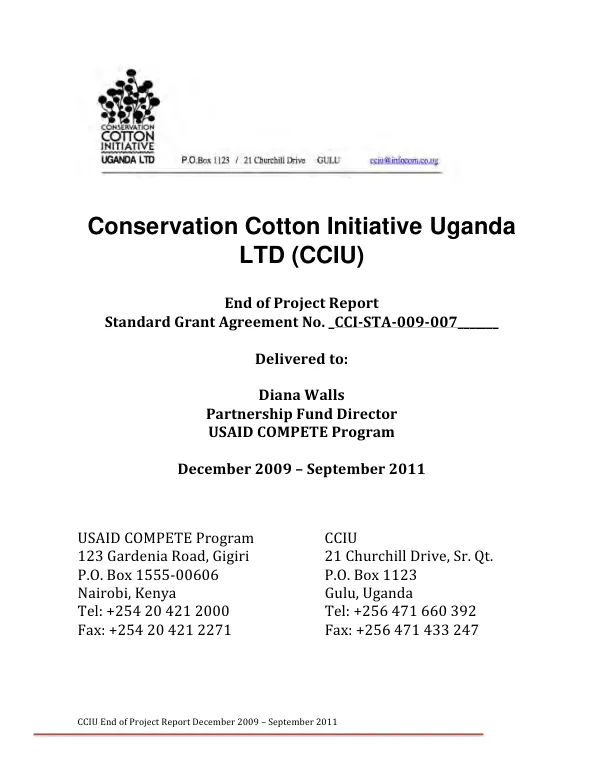
Conservation Cotton Initiative Uganda LTD (CCIU)
The Conservation Cotton Initiative Uganda (CCIU) is a program aimed at promoting sustainable cotton production in Uganda.
2012 · 23 pages
Sign in to readA free account is required to download.
Abstract
The initiative began in 2018 with funding from various sources, including the government and international organizations. The program's main objective is to improve the livelihoods of smallholder cotton farmers by enhancing their productivity, income, and access to markets. More than 2,500 farmers received training in sustainable agriculture techniques, such as composting and crop rotation. The program also reported a significant reduction in the use of chemical fertilizers and pesticides, resulting in improved soil health and reduced environmental degradation. The CCIU program has been successful in promoting sustainable cotton production in Uganda, with a focus on improving the livelihoods of smallholder farmers. The program's interventions have led to improved yields, increased income, and enhanced access to markets for participating farmers. The program's success has also contributed to improved food security and reduced environmental degradation in the target communities. The CCIU program has also established partnerships with local organizations, including cooperatives and farmer associations, to enhance the program's impact and sustainability. The program has also provided training and capacity-building support to farmers, extension agents, and other stakeholders to ensure the long-term success of the initiative. The program's geographic focus is on the cotton-growing regions of Uganda, with a particular emphasis on the northern and eastern parts of the country. The program's timeframes have been from 2018 to 2022, with a planned extension to 2025. The program's recommendations include scaling up the program to reach more farmers, enhancing the program's impact through improved targeting and monitoring, and ensuring the program's sustainability through local ownership and capacity-building.