USAID DEC
Managing Ecosystems and Mitigating Conflict: Local Conventions for Resilience and Economic Growth in the Sahel - Enhanced Resilience Program
Sign inUSAID DEC
Managing Ecosystems and Mitigating Conflict: Local Conventions for Resilience and Economic Growth in the Sahel - Enhanced Resilience Program
The Enhanced Resilience Program in the Sahel region focuses on managing ecosystems and mitigating conflict through the development of local conventions.
2018 · 2 pages
Sign in to readA free account is required to download.
Abstract
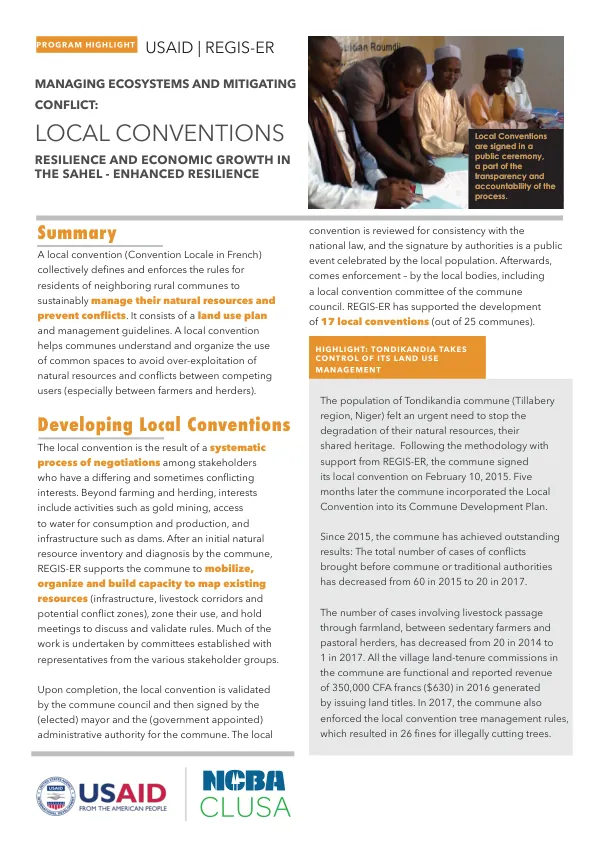
A local convention is a collective agreement among residents of neighboring rural communes to sustainably manage their natural resources and prevent conflicts. It consists of a land use plan and management guidelines that help communes understand and organize the use of common spaces to avoid over-exploitation of natural resources and conflicts between competing users. The development of a local convention is a systematic process of negotiations among stakeholders with differing and sometimes conflicting interests. These stakeholders include farmers, herders, gold miners, and individuals with access to water for consumption and production. The process begins with an initial natural resource inventory and diagnosis by the commune, followed by the mobilization, organization, and capacity building of stakeholders to map existing resources, zone their use, and hold meetings to discuss and validate rules. Much of the work is undertaken by committees established with representatives from the various stakeholder groups. Upon completion, the local convention is validated by the commune council and then signed by the elected mayor and the administrative authority for the commune. The signature is a public event celebrated by the local population, and the convention is reviewed for consistency with national law. REGIS-ER has supported the development of 17 local conventions out of 25 communes in the region. The local convention in Tondikandia commune, Niger, is a notable example of the program's success. The commune signed its local convention on February 10, 2015, and incorporated it into its Commune Development Plan five months later. Since then, the commune has achieved outstanding results, including a significant decrease in conflicts and an increase in revenue generated by issuing land titles. The commune has also enforced the local convention tree management rules, resulting in fines for illegally cutting trees. The development and enforcement of local conventions have suggested best practices that foster sustainability of local governance of natural resources management. These practices include taking time to undertake a bottom-up process, publicizing and mainstreaming the document, monitoring progress, and demonstrating and promoting scale-up. Successful communes have set up monitoring committees to ensure that natural resource management rules are respected, and have facilitated sharing of information and experience between commune leaders to contribute to wider adoption.
Related documents
Documents in this collection
 2018
2018USAID DEC
Conservation Farming and Farmer-Managed Natural Regeneration: Resilience and Economic Growth in the Sahel - Enhanced Resilience Program
Open record 2018
2018USAID DEC