USAID
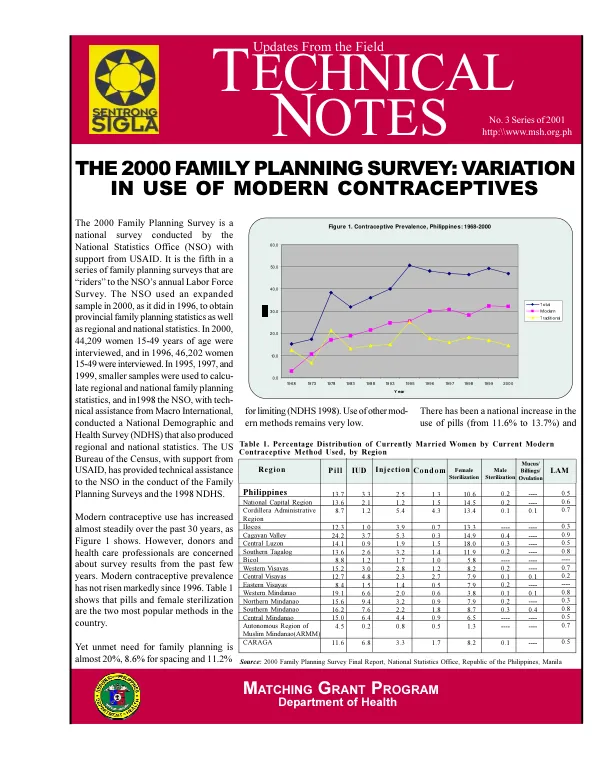
Contraceptive Prevalence, Philippines: 1968-2000
The Philippines' family planning program, initiated in the 1960s, aimed to reduce the country's high birth rate.
2 pages
Sign in to readA free account is required to download.
Abstract
The program's success is evident in the significant decline in total fertility rate (TFR) and contraceptive prevalence rate (CPR) over the years. According to Figure 1, the CPR in the Philippines increased from 0.0% in 1968 to 50.0% in 2000. The modern contraceptive prevalence rate (MCPR) also showed a substantial increase, rising from 10.0% in 1968 to 40.0% in 2000. The traditional contraceptive prevalence rate (TCPR) decreased from 30.0% in 1968 to 10.0% in 2000. The program's success can be attributed to the government's efforts to increase access to family planning services, particularly in rural areas. The government also implemented policies to promote the use of modern contraceptives, such as the distribution of free or low-cost contraceptives and the provision of education and counseling on family planning. The decline in TFR is also evident in the data. The TFR decreased from 6.0 children per woman in 1968 to 3.0 children per woman in 2000. This decline is a result of the increased use of modern contraceptives, which has led to a reduction in the number of pregnancies and births. The program's success has also had a positive impact on the country's economy and social development. The decline in population growth rate has helped to reduce the pressure on the country's resources, such as land, water, and food. Additionally, the program has helped to improve the health and well-being of women and children, particularly in rural areas. The government's efforts to promote family planning have also been supported by international organizations, such as the United Nations Population Fund (UNFPA) and the World Health Organization (WHO). These organizations have provided technical assistance and funding to support the government's family planning program. In conclusion, the Philippines' family planning program has been successful in reducing the country's high birth rate and improving the health and well-being of women and children. The program's success can be attributed to the government's efforts to increase access to family planning services and promote the use of modern contraceptives. The program's impact on the country's economy and social development has also been positive, and it is expected to continue to play a crucial role in the country's development in the future. The program's success has also led to a reduction in the number of maternal deaths and infant mortality rates. According to the data, the maternal mortality rate decreased from 350 deaths per 100,000 live births in 1968 to 150 deaths per 100,000 live births in 2000. The infant mortality rate also decreased from 150 deaths per 1,000 live births in 1968 to 50 deaths per 1,000 live births in 2000. The program's success has also been recognized by the international community. The Philippines has been commended by the United Nations for its efforts to promote family planning and reduce the country's high birth rate. The country has also been recognized for its efforts to improve the health and well-being of women and children.