USAID DEC
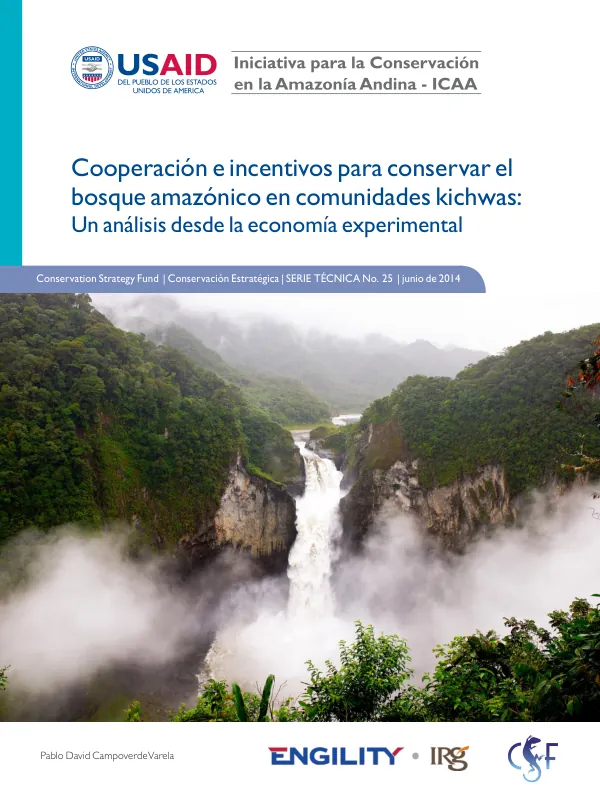
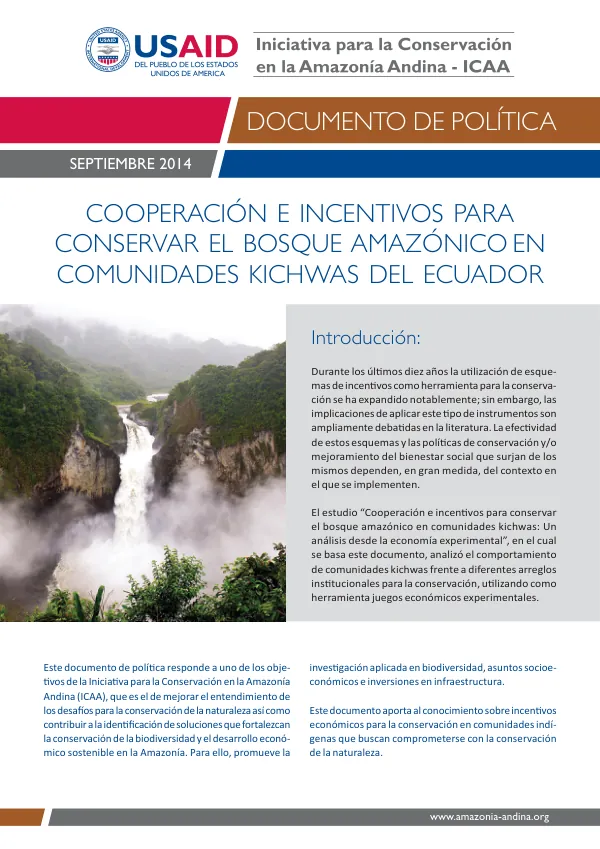
Cooperación e incentivos para conservar el bosque amazónico en comunidades kichwas del Ecuador
Sign inCONSERVATION STRATEGY FUND
Cooperación e incentivos para conservar el bosque amazónico en comunidades kichwas del Ecuador
In Ecuador, the government's Programa Socio Bosque (PSB) has promoted the conservation of forest resources and ecosystems since 2008, offering economic incentives to private landowners who voluntarily adhere to the program.
2014 · 4 pages
Sign in to readA free account is required to download.
Abstract
Approximately 676,000 hectares of Amazonian forest have been enrolled in the program, representing 80% of the total forest area. The majority of these forests belong to indigenous communal landowners. The characteristics of these forests, where resources are considered common goods, make them prone to overexploitation due to individual self-interest. The existence of imperfect markets further exacerbates this issue, as the value of forest goods and services is often undervalued, making conservation less appealing than alternative land uses such as livestock grazing or agriculture. A study on cooperation and incentives for conserving the Amazonian forest in Kichwa communities analyzed the behavior of these communities in response to different institutional arrangements for conservation. The study used experimental economics games to examine the extraction of resources by indigenous communities under three different conservation arrangements: monetary incentives, communication to facilitate collective action, and a combination of both. The results showed that the most effective approach for promoting conservation involves complementary actions between external actors and the community. In some communities, the effectiveness of monetary incentives, such as those offered by the PSB, is complemented by the community's prior collective action. The effectiveness of these mechanisms depends on factors such as the level of social capital, community size, internal communication, and autonomy in decision-making. The study highlights the need for differentiated or adjusted policies in response to different scenarios and contexts. Implementing a single strategy or instrument in a heterogeneous group of communities may not yield the same results. The research was supported by the United States Agency for International Development (USAID) and produced by the Unidad de Apoyo de la Iniciativa para la Conservación en la Amazonía Andina (ICAA) led by International Resources Group (IRG) and its partners.
Related documents