USAID DEC
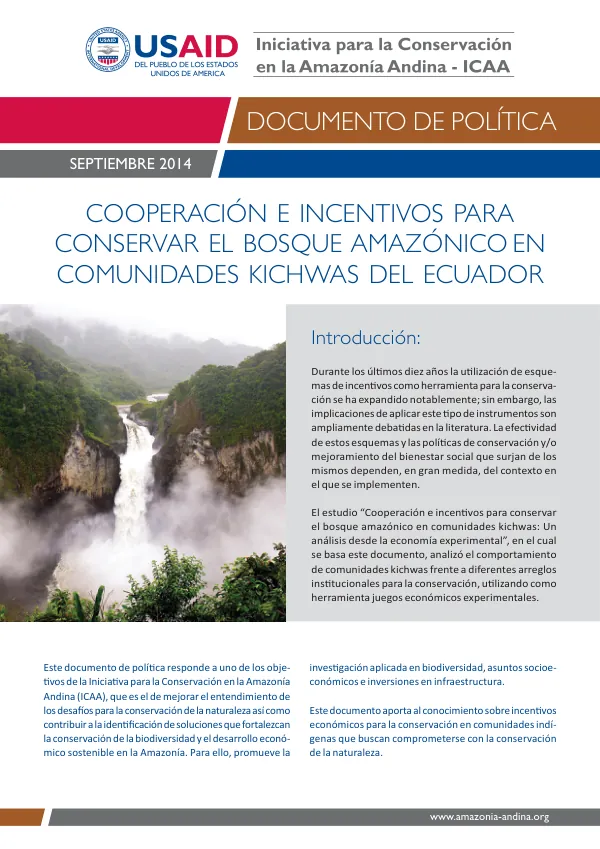
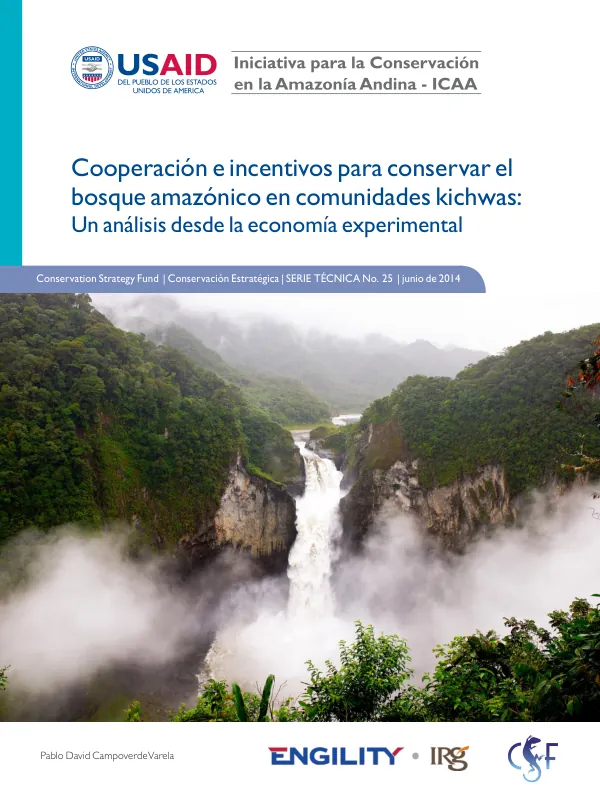
Cooperación e incentivos para conservar el bosque amazónico en comunidades kichwas: Un análisis desde la economía experimental
Sign inCONSERVATION STRATEGY FUND
Cooperación e incentivos para conservar el bosque amazónico en comunidades kichwas: Un análisis desde la economía experimental
In contrast, the study on cooperation and incentives for conserving the Amazonian forest in Kichwa communities, conducted in 2014, focused on the economic analysis of conservation strategies.
2014 · 80 pages
Sign in to readA free account is required to download.
Abstract
The research was led by Pablo David Campoverde Varela and supported by the Conservation Strategy Fund (CSF) and the USAID's Amazon Conservation Initiative. The study aimed to evaluate the effectiveness of cooperation and incentives in promoting forest conservation among Kichwa communities in the Amazon region. The research methodology involved a combination of theoretical modeling and experimental design. The study used a game-theoretic approach to analyze the behavior of Kichwa communities in response to different conservation strategies. The researchers conducted a series of economic experiments, known as "Juegos Económicos Experimentales" (JEE), in which participants were presented with scenarios that simulated the effects of cooperation and incentives on forest conservation. The study found that the treatment of incentives, which involved offering financial rewards for conservation efforts, was effective in increasing the extraction of forest products among participants. However, the treatment of communication, which involved providing information on the benefits of conservation, had a more significant impact on the extraction of forest products when combined with incentives. The study also found that the treatment of incentives combined with communication led to a higher level of compliance with conservation restrictions among participants. The results of the study suggest that cooperation and incentives can be effective tools for promoting forest conservation among Kichwa communities in the Amazon region. However, the study also highlights the importance of considering the specific context and needs of each community when designing conservation strategies. The study's findings have implications for the development of effective conservation policies and programs in the Amazon region. The study's methodology and results are presented in detail in the report, which includes a comprehensive analysis of the data collected during the economic experiments. The report also provides an overview of the study's context, including the location and characteristics of the Kichwa communities involved in the research. The study's findings are presented in a series of tables and figures, which provide a detailed analysis of the data collected during the research.