USAID DEC
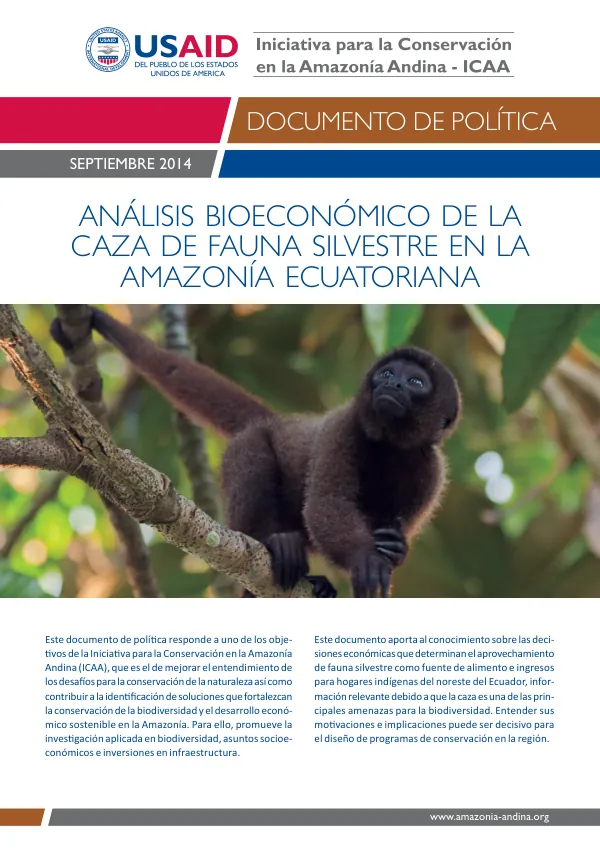
Documento de Política - Análisis Bioeconómico de la Caza de Fauna Silvestre en la Amazonía Ecuatoriana
Sign inCONSERVATION STRATEGY FUND
Documento de Política - Análisis Bioeconómico de la Caza de Fauna Silvestre en la Amazonía Ecuatoriana
The Iniciativa para la Conservación en la Amazonía Andina (ICAA) aims to improve understanding of the challenges for nature conservation and contribute to the identification of solutions that strengthen biodiversity conservation and sustainable economic development in the Amazon region.
2014 · 4 pages
Sign in to readA free account is required to download.
Abstract
To achieve this goal, ICAA promotes applied research in biodiversity, socio-economic issues, and infrastructure investments. A bioeconomic analysis of wildlife hunting in the Ecuadorian Amazon was conducted to provide knowledge on the economic decisions that determine the exploitation of wild fauna as a source of food and income for indigenous households in the northeastern region of Ecuador. This information is relevant because hunting is one of the main threats to biodiversity. Understanding the motivations and implications of hunting can be crucial for designing conservation programs in the region. The commercialization and consumption of wild fauna as food is an important economic activity in most tropical countries. However, this exploitation is often unsustainable, making it one of the main threats to biodiversity. The Amazon regions are no exception. Despite the importance of this resource, little is known about the economic decisions that determine its exploitation. A study titled "La caza de fauna silvestre en la región amazónica del noreste de Ecuador: Análisis bioeconómico de su uso como fuente de proteína para nacionalidades indígenas" analyzed the hunting of wild fauna as a source of food for indigenous households in three communities in the Amazon region of northeastern Ecuador. The study used a bioeconomic model to analyze the hunting of wild fauna as a source of food for households in the communities of Dureno, Wajosara, and Cuyabeno, located in the Cuyabeno Wildlife Production Reserve and its surroundings. The model represents a representative indigenous household that makes decisions about hunting levels, fishing, consumption of wild meat at home, the amount of wild meat sold, and the time dedicated to hunting, fishing, and working outside the community to maximize its well-being. To do this, the household must consider its budget constraints, available time, and technologies used to develop hunting and fishing activities. The theoretical model was calibrated with information collected over six months about the quantities of animals hunted and fished, hunting and fishing effort, consumption of protein at home, costs of inputs for hunting and fishing, and sales of wild meat and fish. The results of the study show that wild fauna is the main source of protein for most households, with an average consumption of 141 grams of wild meat and fish per day per inhabitant in the study communities. A basic conclusion is that if conservation and development policies were to prevent these communities from obtaining animal protein from wild sources, it would be necessary to guarantee realistic access to alternative protein sources. The work outside the household as a hired worker is the main source of income in all communities, representing more than 93% of income in Dureno and Cuyabeno, while in Wajosara it represents 47%. The sale of wild meat and fish is a rare activity that generates little monetary income for the household. The study found that variations in the costs associated with hunting (such as an increase in the price of ammunition) would have little impact on the time dedicated to hunting and fishing activities. However, as costs increase, the consumption of wild meat at home would decrease, while the proportion sold would increase. This could be associated with the fact that wild meat is considered a basic necessity, but if costs increase, hunters may need to recover them by selling the meat. A relevant implication is that an increase in costs could lead to an increase in the illegal trade of wild meat in the region. The study also found that an increase in the prices of wild meat and fish would lead to an increase in the capture of animals and the time dedicated to hunting and fishing. Additionally, with higher prices, there would be a greater incentive to sell a larger proportion of what is captured, which would initially lead to an increase in the illegal trade. This could lead to overexploitation of species and a decline in their population, resulting in a reduction in the offer and well-being of the communities. The study suggests that measures to prevent the illegal trade of wild meat, such as confiscation of animals and a fine of over $10, could have a significant impact on the time dedicated to hunting for sale. However, the benefits of applying this measure for biodiversity and conservation of the hunting resource in the study area would be limited, as the proportion of wild meat sold in the communities is small. Finally, the study found that an increase in salaries for workers would increase the incentives to work outside the household and, therefore, the opportunity cost of hunting. The increase in salaries would also reduce the proportion of wild meat sold. Therefore, it appears that reducing poverty through increased salaries would improve biodiversity conservation by breaking the rural dependence on wild life. However, it is possible that the positive impact could be offset if hunters invest their new income in more efficient techniques or if development increases demand. The ambiguity of the effects of economic development suggests that conservation policies through the increase of income from productive activities may be less effective than