JSI RESEARCH & TRAINING INSTITUTE, INC
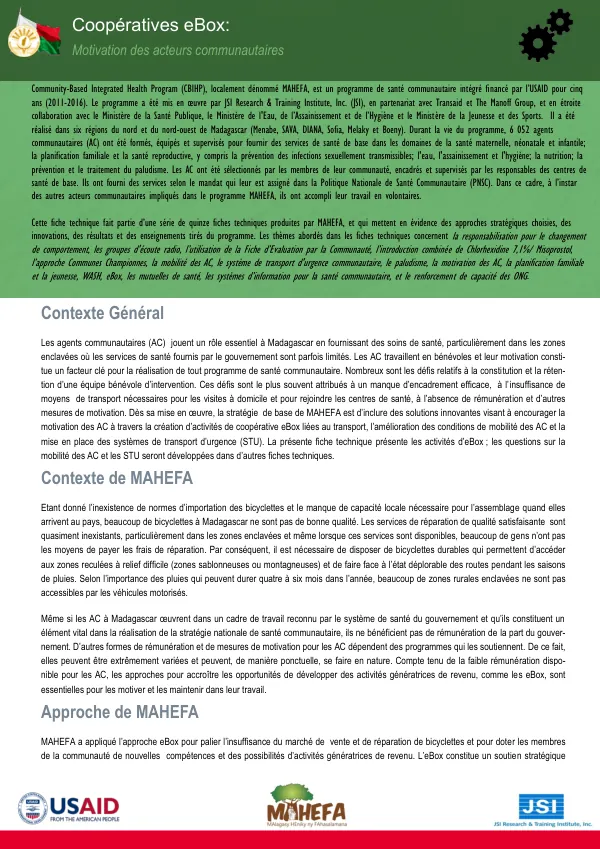
Coopératives eBox: Motivation des acteurs communautaires
The Community-Based Integrated Health Program (CBIHP), also known as MAHEFA, is a community-based health program funded by the United States Agency for International Development (USAID) for a period of five years (2011-2016).
2016 · 4 pages
Sign in to readA free account is required to download.
Abstract
The program was implemented by JSI Research & Training Institute, Inc. (JSI) in partnership with Transaid and The Manoff Group, and in close collaboration with the Ministry of Public Health, the Ministry of Water, Sanitation and Hygiene, and the Ministry of Youth and Sports. The program was implemented in six regions in the north and northwest of Madagascar, including Menabe, SAVA, DIANA, Sofia, Melaky, and Boeny. A total of 6,052 community health workers (CHWs) were trained, equipped, and supervised to provide basic health services in areas such as maternal, neonatal, and child health; family planning and reproductive health, including the prevention of sexually transmitted infections; water, sanitation, and hygiene; nutrition; and malaria prevention and treatment. The CHWs were selected by their community members, supervised by health center staff, and worked on a voluntary basis. The program aimed to address the challenges faced by CHWs, including inadequate supervision, limited mobility, and lack of motivation. To address these challenges, the program introduced the eBox cooperative, which provided a platform for CHWs to develop income-generating activities and improve their mobility. The eBox cooperative was established in four pilot communes in the Sofia and Menabe regions, where CHWs were trained to repair and maintain bicycles, and to provide transportation services to their communities. The eBox cooperative was designed to provide a sustainable solution to the challenges faced by CHWs, including the lack of access to quality bicycles and the limited availability of repair services. The program worked with international partners to collect and distribute bicycles and spare parts to the eBox cooperative, which was established in four communes in the Sofia and Menabe regions. The cooperative was registered with the local authorities and was composed of a management committee, a sales team, and a repair team. The eBox cooperative provided a range of services, including bicycle sales, repair, and maintenance, as well as transportation services to the community. The program also introduced a system of community-based transportation, which was managed by the eBox cooperative and provided transportation services to the community. The eBox cooperative was designed to be self-sustaining, with the goal of generating income for the CHWs and improving their motivation and retention. The program achieved significant results, including the training of over 6,000 CHWs, the distribution of over 1,000 bicycles, and the establishment of a community-based transportation system. The program also introduced a range of innovations, including the use of bicycles as ambulances, and the establishment of a system of community-based insurance for health services. The program's results demonstrate the potential of community-based health programs to improve health outcomes and promote community development. The eBox cooperative was a key component of the program, providing a platform for CHWs to develop income-generating activities and improve their mobility. The cooperative was established in four pilot communes in the Sofia and Menabe regions, where CHWs were trained to repair and maintain bicycles, and to provide transportation services to their communities. The cooperative was designed to be self-sustaining, with the goal of generating income for the CHWs and improving their motivation and retention. The program's results demonstrate the potential of community-based health programs to improve health outcomes and promote community development. The eBox cooperative was a key component of the program, providing a platform for CHWs to develop income-generating activities and improve their mobility. The cooperative was established in four pilot communes in the Sofia and Menabe regions, where CHWs were trained to repair and maintain bicycles, and to provide transportation services to their communities. The program's achievements were recognized by the government of Madagascar, which acknowledged the program's contribution to the country's health development. The program's results also demonstrate the potential of community-based health programs to improve health outcomes and promote community development. The eBox cooperative was a key component of the program, providing a platform for CHWs to develop income-generating activities and improve their mobility.
Related documents
Documents in this collection
 2016
2016USAID DEC
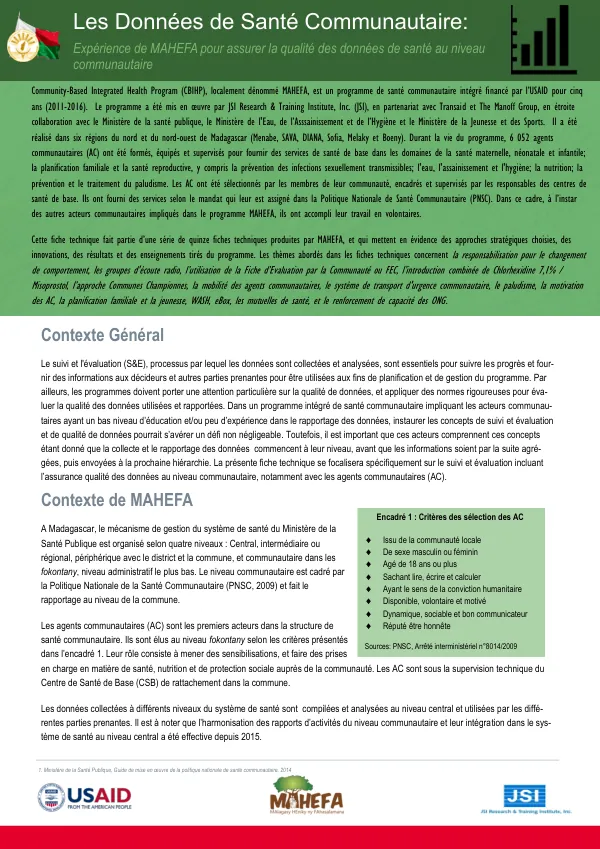
Les Données de Santé Communautaire: Expérience de MAHEFA pour assurer la qualité des données de santé au niveau communautaire
Open record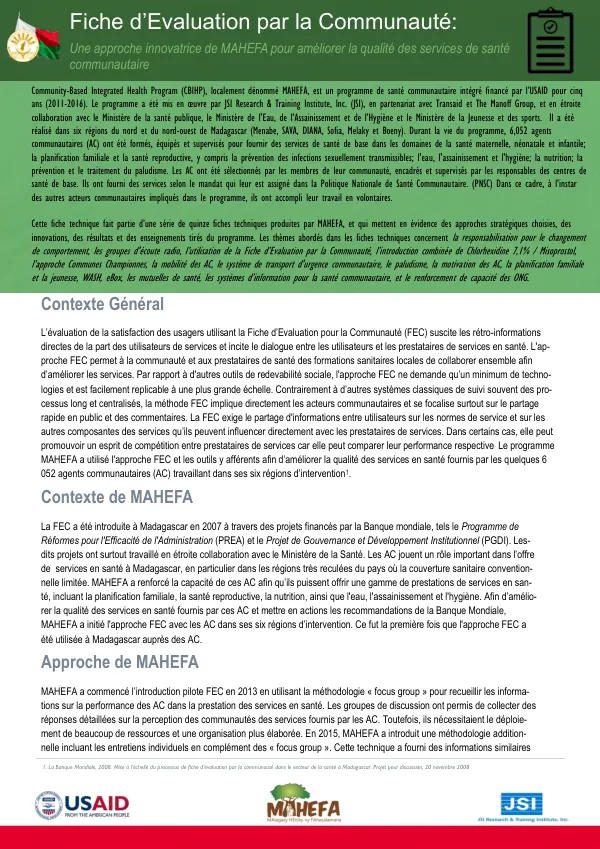 2016
2016USAID DEC
Fiche d’Evaluation par la Communauté: Une approche innovatrice de MAHEFA pour améliorer la qualité des services de santé communautaire
Open record