USAID DEC
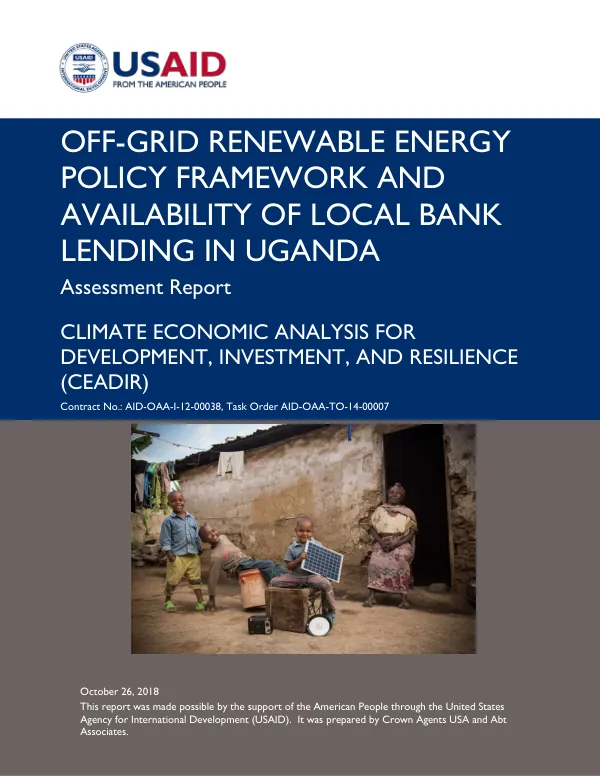
Off-Grid Renewable Energy Policy Framework and Availability of Local Bank Lending in Uganda
Sign inABT ASSOCIATES
Off-Grid Renewable Energy Policy Framework and Availability of Local Bank Lending in Uganda
The off-grid renewable energy policy framework in Uganda is influenced by various government entities, including the Ministry of Energy and Mineral Development (MEMD), the Energy Regulatory Authority (ERA), and the Rural Electrification Agency (REA).
2018 · 28 pages
Sign in to readA free account is required to download.
Abstract
The National Development Plan II (NDP II) sets a target of increasing access to electricity to 90% of the population by 2030. The Rural Electrification Strategy and Plan II (RESP II) aims to increase access to electricity in rural areas through the use of off-grid renewable energy sources. The policy framework for off-grid renewable energy in Uganda is guided by several key documents, including the National Energy Policy, the Renewable Energy Policy, and the Rural Electrification Policy. These documents emphasize the importance of increasing access to electricity, promoting the use of renewable energy sources, and supporting the development of the off-grid renewable energy sector. The availability of local bank lending for off-grid renewable energy in Uganda is a critical factor in the development of the sector. The Development Finance Company of Uganda (DFCU) has been actively involved in providing financing for off-grid renewable energy projects, including solar home systems and mini-grids. The Uganda Energy Credit Capitalization Company (UECCC) has also been established to provide financing for off-grid renewable energy projects. A study conducted by CEADIR found that the majority of Ugandan banks have limited experience in lending for off-grid renewable energy projects. However, there is a growing interest in the sector, and several banks have expressed a willingness to provide financing for off-grid renewable energy projects. The study also found that the availability of bank loans and their lending terms and conditions are critical factors in determining the feasibility of off-grid renewable energy projects. The report highlights the importance of increasing access to electricity in Uganda, particularly in rural areas. It also emphasizes the need for a supportive policy framework and the availability of local bank lending to facilitate the development of the off-grid renewable energy sector. The report provides recommendations for increasing access to electricity, promoting the use of renewable energy sources, and supporting the development of the off-grid renewable energy sector in Uganda. The report also highlights the role of the Uganda Off-Grid Market Accelerator (UOMA) in promoting the development of the off-grid renewable energy sector. UOMA provides technical assistance and training to commercial banks in Uganda to help them scale up off-grid renewable energy lending. The report also emphasizes the importance of linking banks to clean energy companies, developers, and potential investors to facilitate commercial lending for off-grid renewable energy projects. In terms of implementation, the report recommends that the government of Uganda should establish a clear policy framework for off-grid renewable energy, including a regulatory framework and a financing mechanism. The report also recommends that the government should provide incentives for commercial banks to lend for off-grid renewable energy projects, such as tax breaks and subsidies. Additionally, the report recommends that the government should establish a monitoring and evaluation system to track the progress of off-grid renewable energy projects and identify areas for improvement. In conclusion, the off-grid renewable energy policy framework in Uganda is influenced by various government entities, and the availability of local bank lending is a critical factor in the development of the sector. The report provides recommendations for increasing access to electricity, promoting the use of renewable energy sources, and supporting the development of the off-grid renewable energy sector in Uganda.
Related documents
Documents in this collection
 2021
2021USAID DEC
Effectiveness Assessment for Expanding Small-Scale, Off-Grid Renewable Energy Lending in Ghana, Rwanda, and Uganda: Climate Economic Analysis for Development, Investment, and Resilience (CEADIR)
Open record 2021
2021USAID DEC