USAID DEC
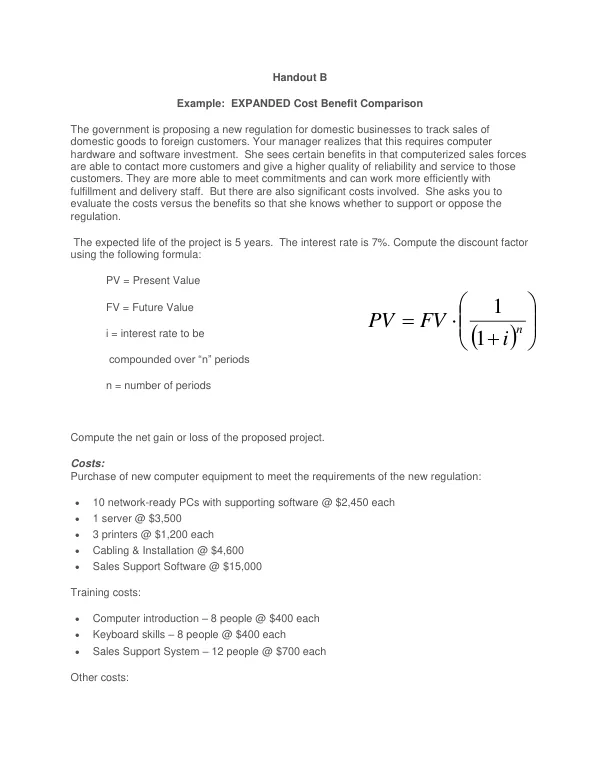
Cost Benefit Comparison of Proposed Regulation
The proposed regulation for domestic businesses to track sales of domestic goods to foreign customers requires significant investment in computer equipment and software.
2013 · 2 pages
Sign in to readA free account is required to download.
Abstract
The expected lifespan of the project is 5 years, and the interest rate is 7%. To evaluate the costs versus the benefits of the project, the discount factor must be calculated using the formula: PV = FV / (1 + i)^n, where PV is the present value, FV is the future value, i is the interest rate, and n is the number of periods. The costs associated with the project include the purchase of 10 network PCs with supporting software at $2,450 each, totaling $24,500. Additionally, a server at $3,500, 3 printers at $1,200 each, totaling $3,600, cabling and installation at $4,600, sales support software at $15,000, and training costs for computer introduction, keyboard skills, and sales support system are estimated at $3,200, $3,200, and $8,400, respectively. Other costs include lost time, lost sales through disruption, and lost sales through inefficiency, estimated at $8,000, $20,000, and $20,000, respectively. The total cost of the project is $73,200. The benefits of the project include tripling of mail, sustaining telesales campaigns, improved efficiency and reliability of follow-up, customer service and retention, accuracy of customer information, and ability to manage sales effort, estimated at $40,000, $20,000, $50,000, $30,000, $10,000, and $30,000 per year, respectively. The total benefit of the project is $180,000 per year. To calculate the net gain or loss of the proposed project, the present value of the costs and benefits must be calculated using the discount factor. The present value of the costs is $73,200, and the present value of the benefits is $180,000 / (1 + 0.07)^5. The net gain or loss of the proposed project is the difference between the present value of the benefits and the present value of the costs.
Related documents
Documents in this collection
 2015
2015USAID DEC
Georgia Energy Regulatory Partnership: Technical Assistance on Electricity Distribution System Operations and Development of Grid Code
Open record 2014
2014USAID DEC