USAID DEC
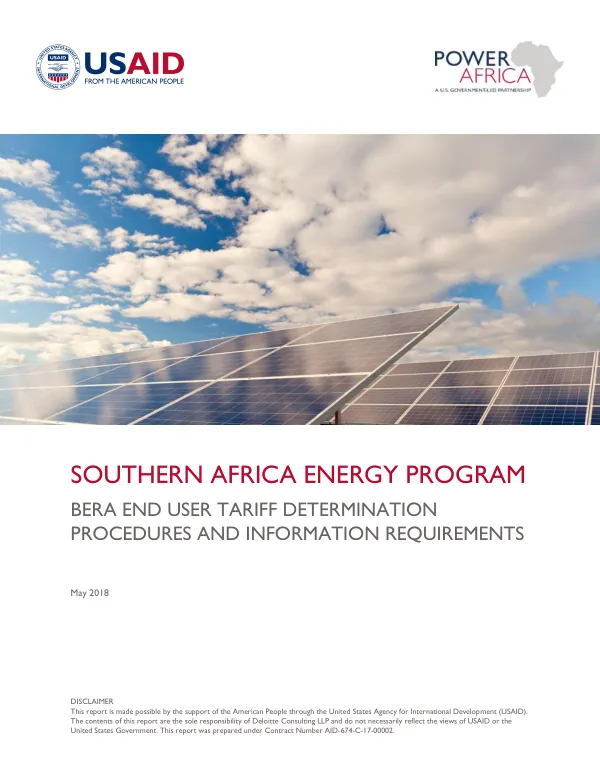
Southern Africa Energy Program: BERA End User Tariff Determination Procedures and Information Requirements
Sign inDELOITTE CONSULTING, LLP
Southern Africa Energy Program: BERA End User Tariff Determination Procedures and Information Requirements
The Botswana Energy Regulatory Authority (BERA) is responsible for determining electricity tariffs for customers directly regulated by the authority.
2018 · 9 pages
Sign in to readA free account is required to download.
Abstract
The tariff determination process is guided by the BERA Act of 2016, which mandates BERA to create tariffs that are reflective of reasonable cost, promote investment in the energy sector, and ensure security of supply. The process begins with a tariff application submitted by the utility, which must be lodged six months before the start of the new tariff period. BERA reviews the application to ensure it conforms to the Tariff Guidelines and notifies the applicant that the application is duly submitted within seven days of its submission. If the application is not duly lodged, BERA rejects it and notifies the applicant within five days of receipt, providing reasons for the rejection. Once the application is duly lodged, BERA notifies the public and the utility of the review in both print and electronic media. The notice specifies the proposed tariff adjustment in percentage terms per customer category, the current tariffs and proposed tariffs in monetary terms per customer category, reasons for the proposed tariff adjustment, and areas where revenues derived from the proposed tariffs will be applied to. BERA issues a Public Consultation Paper (PCP) for a period of 30 days in the print and electronic media, inviting consumers to submit written submissions on the tariff application. The PCP may include information from the application, and the utility shall indicate in the application which information is deemed confidential. Written submissions from consumers and the public received by BERA are availed to the utility before public hearings are held. Following receipt of submissions from consumers and members of the public, BERA may convene a public inquiry in selected parts of the country, where the public and the applicant are given an opportunity to present their views. The tariff determination and announcement are made after the public inquiry, and the process is guided by the principles of transparency, fairness, and accountability. The tariff determination process is based on the principles underlying revenue requirement, which includes allowable operating and maintenance expenses, allowable depreciation expense, rate of return, rate base or regulatory asset base, and asset valuation. The process also involves the consideration of various factors, including the need to create tariffs that are reflective of reasonable cost, promote investment in the energy sector, and ensure security of supply. The Government of Botswana's National Energy Policy (NEP) of 2017 seeks to expand generation in excess of national demand while ensuring affordable and appropriately priced energy for local consumption. The policy aims to migrate electricity tariffs to a cost-reflective status, and BERA is guided by this objective in determining electricity tariffs. The tariff determination process is designed to ensure that tariffs are fair, transparent, and reflective of the costs of providing electricity services to customers.