USAID DEC
Costed Implementation Plan for Family Planning in Ethiopia, 2015-2020
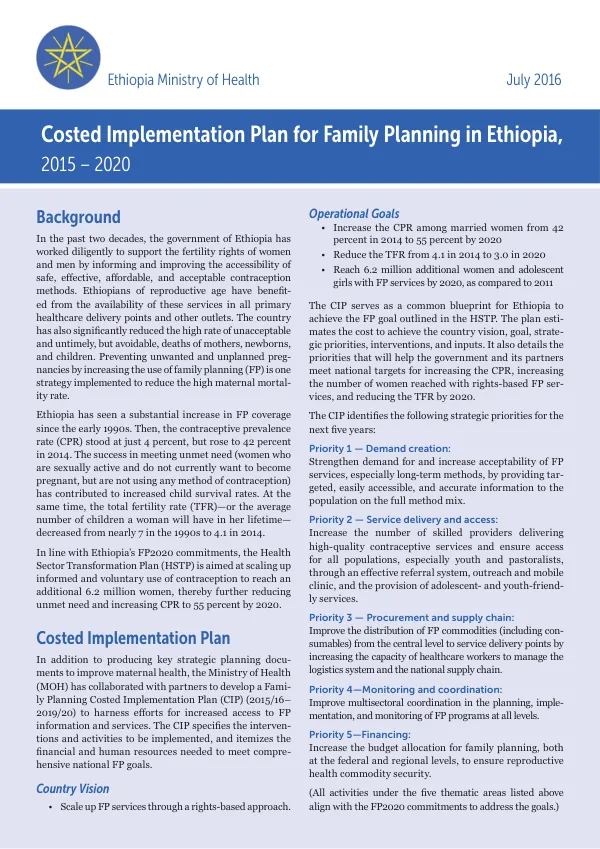
The Family Planning Costed Implementation Plan for Ethiopia aims to scale up informed and voluntary use of contraception to reach an additional 6.2 million women, thereby further reducing unmet need and increasing the contraceptive prevalence rate (CPR) to 55 percent by 2020.
2016 · 4 pages
Sign in to readA free account is required to download.
Abstract
The plan is aligned with Ethiopia's Family Planning 2020 commitments and is part of the Health Sector Transformation Plan. The plan identifies five strategic priorities for the next five years: demand creation, service delivery and access, procurement and supply chain, monitoring and coordination, and financing. Demand creation involves strengthening demand for and increasing acceptability of family planning services, especially long-term methods, by providing targeted, easily accessible, and accurate information to the population. Service delivery and access involves increasing the number of skilled providers delivering high-quality contraceptive services and ensuring access for all populations, especially youth and pastoralists. The plan estimates the cost to achieve the country vision, goal, strategic priorities, interventions, and inputs. It also details the priorities that will help the government and its partners meet national targets for increasing the CPR, increasing the number of women reached with rights-based family planning services, and reducing the total fertility rate (TFR) by 2020. The total costs of the plan from 2015 to 2020 are estimated to be US$285 million, with 75 percent of overall costs in commodities, including contraceptives and consumables. The cost per woman of reproductive age for activity costs is estimated to be US$0.47 per year, significantly lower than comparable costs in other countries. The lower activity costs in Ethiopia are largely due to the economies of scale generated in conducting national programs for such a large population, as well as government policies that aim to lower activity costs. The method mix projections are based on five assumptions guided by best practices and by recommendations from stakeholders and expert groups. The greatest rise in long-acting reversible contraceptives (LARCs) is expected to be for implants, accompanied by an increased demand for intrauterine devices (IUCDs) and female sterilization. The activities outlined in the plan will lead to a CPR of 55 percent for all married women in 2020, a modern prevalence rate (mCPR) of 54 percent among married women, and mCPR of 83 percent among unmarried sexually active women. The impact of increasing CPR to 55 percent by 2020 is estimated to be significant, with a total of 10 million women using contraception in 2020. The plan is expected to lead to a reduction in the TFR from 4.1 in 2014 to 3.0 in 2020, and an increase in household income among program participants compared to the control group.
Related documents