USAID DEC
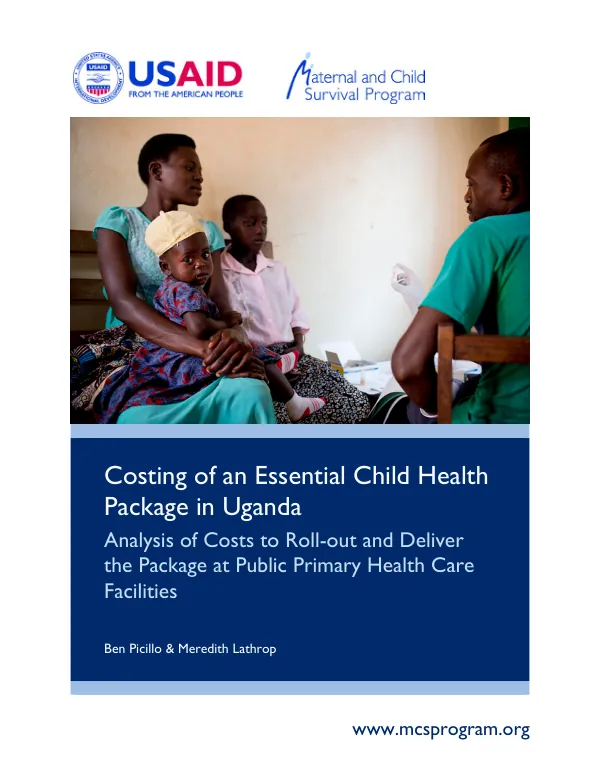
Costing of an Essential Child Health Package in Uganda: Analysis of Costs to Roll-out and Deliver the Package at Public Primary Health Care Facilities
Sign inUSAID
Costing of an Essential Child Health Package in Uganda: Analysis of Costs to Roll-out and Deliver the Package at Public Primary Health Care Facilities
The Maternal and Child Survival Program (MCSP) is a global initiative to introduce and support high-impact health interventions in 25 priority countries, including Uganda.
2019 · 45 pages
Sign in to readA free account is required to download.
Abstract
MCSP focuses on maternal, newborn, and child health, immunization, family planning and reproductive health, nutrition, health systems strengthening, water/sanitation/hygiene, malaria, prevention of mother-to-child transmission of HIV, and pediatric HIV care and treatment. The program tackles these issues through approaches that also focus on household and community mobilization, gender integration, and digital health. The Essential Child Health Package (ECHP) is a critical component of MCSP's efforts in Uganda. ECHP aims to improve child health outcomes by providing essential health services, including immunization, nutrition, and disease prevention. The package is designed to be delivered at public primary health care facilities, which are the primary entry points for health services in Uganda. The costing of ECHP in Uganda is a critical component of the program's implementation. The report provides a detailed analysis of the costs associated with rolling out and delivering ECHP at public primary health care facilities. The analysis focuses on the costs of training and mentorship, facility roll-out, and government scale-up. The report identifies several key findings related to the costing of ECHP. The average cost per trainer trained is estimated to be around $1,500, with costs varying by training methodology and facility level. The average facility training and mentorship combined costs are estimated to be around $10,000, with costs varying by training methodology and facility level. The report also estimates the annual costs of delivering ECHP at public primary health care facilities, with costs ranging from $5,000 to $20,000 per facility per year, depending on the region and facility level. The report also provides a detailed analysis of the costs associated with different components of ECHP, including immunization, nutrition, and disease prevention. The analysis shows that the costs of ECHP components vary by region and facility level, with the highest costs associated with immunization and disease prevention. The report also estimates the costs of ECHP delivery at the district level, with costs ranging from $50,000 to $200,000 per district per year, depending on the region and district level. The report concludes that the costing of ECHP in Uganda is a critical component of the program's implementation. The analysis provides a detailed understanding of the costs associated with rolling out and delivering ECHP at public primary health care facilities, which can inform policy and programming decisions. The report also highlights the importance of considering the costs of different components of ECHP and the need for further analysis to inform the scaling up of ECHP in Uganda. The report highlights the importance of considering the costs of different components of ECHP and the need for further analysis to inform the scaling up of ECHP in Uganda. The report also emphasizes the need for continued support for ECHP implementation in Uganda, including funding for training and mentorship, facility roll-out, and government scale-up.
Related documents