ABT ASSOCIATES
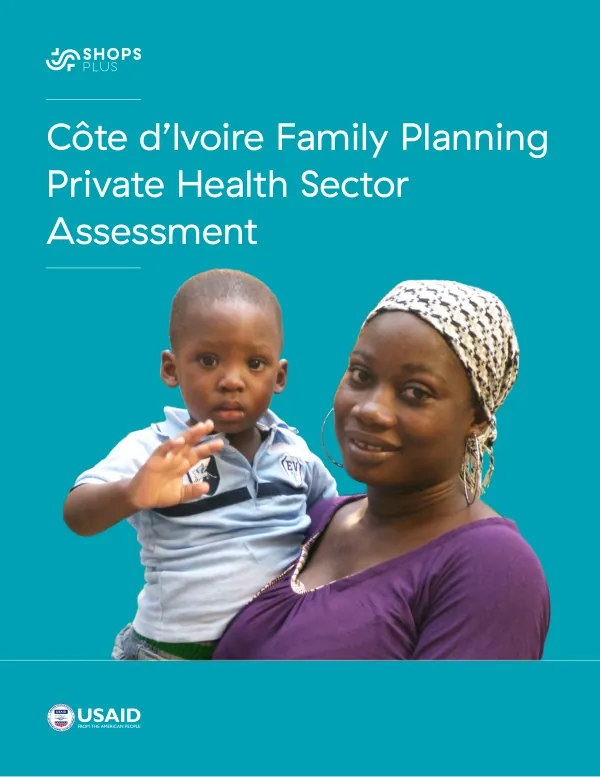
Côte d’Ivoire Family Planning Private Health Sector Assessment
Côte d'Ivoire's economic and political progress has led to a number of health challenges persisting in the country.
2018 · 24 pages
Sign in to readA free account is required to download.
Abstract
Despite achieving lower middle-income status, fertility rates remain high at 5 children per woman, neonatal mortality rates are 38 deaths per 1,000 live births, and maternal mortality rates are 645 deaths per 100,000 live births. Only 17 percent of women and 15 percent of married women used a modern contraceptive method as of 2016, with only 34 percent of demand for modern methods successfully satisfied. As a result, nearly one-third of all adolescent girls have given birth or are currently pregnant. The government, in partnership with international donors, seeks to improve the country's ability to meet the demand for family planning information, products, and services. Achieving this goal requires the participation of both the public and private sectors, yet there is limited information on the private market for family planning products and services in Côte d'Ivoire. The private sector, which includes for-profit and nonprofit providers and organizations, plays an important role in service delivery, but data on this sector are outdated. The private health sector in Côte d'Ivoire is dominated by for-profit facilities, with a well-developed pharmaceutical distribution network. However, private facilities face difficulties attracting highly skilled providers and must hire public sector specialists under the widespread convention of "dual practice." Up to 70 percent of physicians and 50 percent of other health workers engage in dual practice. Private providers in Côte d'Ivoire tend to struggle with limited opportunities for training, low access to financing for equipment and infrastructure, and a lack of representation in discussions about health policy and law. The assessment found that private facilities tend to be concentrated in urban areas, especially in and around Abidjan, although both for-profit and nonprofit facilities are found throughout the country. Many of these facilities operate outside of the formal health system. As of 2015, nearly three-quarters of private facilities did not have formal authorization from the Ministry of Health and Public Hygiene. There are multiple organizations in Côte d'Ivoire that represent and advocate for private providers, including professional councils, professional associations, and industry/business associations. The assessment aimed to identify opportunities and provide recommendations for USAID/Côte d'Ivoire to support increased access to and use of modern family planning methods through the private sector. The assessment focused on the following areas and objectives: policy and health sector overview, demand for family planning in the private sector, and supply of family planning products and services in the private sector. The assessment team conducted interviews with more than 30 key stakeholders in the public and private health sectors in Abidjan and Yamoussoukro in May and June 2017. The analysis began in country, where the assessment team shared findings with government and private sector stakeholders, determined whether additional key informants should be added, and began to form practicable recommendations.
Related documents