DAI
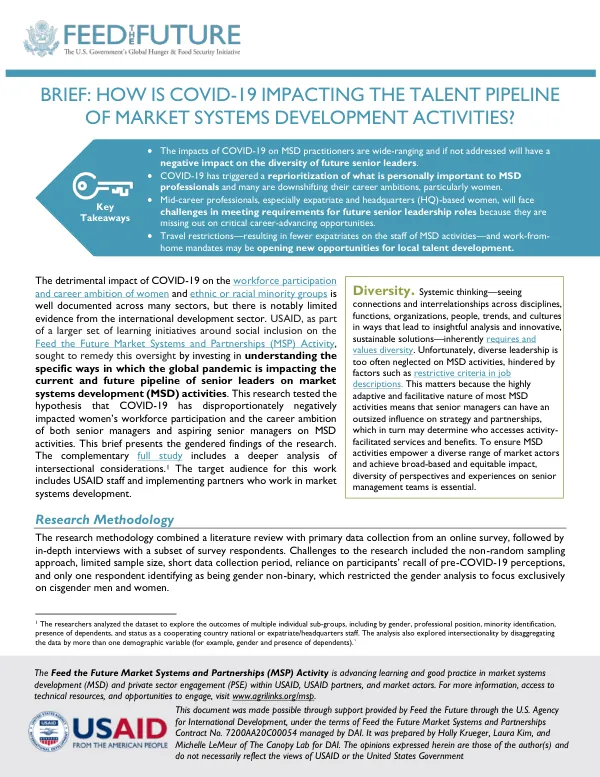
COVID-19 Impact on the Talent Pipeline of Market Systems Development Activities
The detrimental impact of COVID-19 on the workforce participation and career ambition of women and ethnic or racial minority groups is well-documented across many sectors.
2021 · 6 pages
Sign in to readA free account is required to download.
Abstract
However, there is limited evidence from the international development sector. USAID sought to remedy this oversight by investing in understanding the specific ways in which the global pandemic is impacting the current and future pipeline of senior leaders on market systems development (MSD) activities. Research was conducted to test the hypothesis that COVID-19 has disproportionately negatively impacted women's workforce participation and the career ambition of both senior managers and aspiring senior managers on MSD activities. The research combined a literature review with primary data collection from an online survey, followed by in-depth interviews with a subset of survey respondents. Challenges to the research included the non-random sampling approach, limited sample size, short data collection period, reliance on participants' recall of pre-COVID-19 perceptions, and only one respondent identifying as being gender non-binary, which restricted the gender analysis to focus exclusively on cisgender men and women. The research found that MSD professionals, and women in particular, are being stretched on and off the job and some are at risk of burnout. Women were more likely to report an increase in unpaid care work, professional working hours, and work responsibilities. Among those who reported increased unpaid care hours, 56 percent of women stated that they were "dissatisfied" or "very dissatisfied" with the increase in unpaid care work. Respondents attributed their dissatisfaction to an increase in household responsibilities, such as home schooling, and unsustainable demands on their time. The effects of these substantive changes are pushing some MSD professionals, particularly women, to the brink of burnout, many of whom feel like they cannot reach out to their organization and ask for help. COVID-19 has triggered a recalibration of priorities for many MSD professionals. For some, that means spending more time with family and taking advantage of the reduction in travel or commute times. For others, it means seeking work that is less taxing. Regardless of the reason, many MSD professionals are downshifting their career ambitions because of COVID-19. Women reported a greater decrease in ambition than men, but men were more likely to report low or very low levels of ambition. Almost 40 percent of women stated that they wanted to decrease the size and scope of responsibilities in their next assignment, which is a greater percentage compared to men (19 percent) regardless of position, nationality, and presence of dependents. The unsustainability of balancing work and personal responsibilities is a significant concern for MSD professionals, particularly women, who are shouldering a disproportionate burden of unpaid care work. The research highlights the need for MSD activities to prioritize diversity and inclusion, particularly in senior leadership positions. The highly adaptive and facilitative nature of most MSD activities means that senior managers can have an outsized influence on strategy and partnerships, which in turn may determine who accesses activity-facilitated services and benefits. To ensure MSD activities empower a diverse range of market actors and achieve broad-based and equitable impact, diversity of perspectives and experiences on senior management teams is essential. The findings of this research have significant implications for MSD activities and the international development sector as a whole. They highlight the need for organizations to prioritize diversity and inclusion, provide support for MSD professionals who are shouldering a disproportionate burden of unpaid care work, and develop strategies to address the burnout and career ambition challenges faced by women and other underrepresented groups.