USAID DEC
Coyuntura Electoral/Breve Análisis – Impacto Consultores Asociados
The Corte Suprema de Justicia, under the leadership of the Secretaría de Planificación y Desarrollo Institucional, initiated a process of prioritization of projects established in the Plan Estratégico Quinquenal.
2012 · 18 pages
Sign in to readA free account is required to download.
Abstract
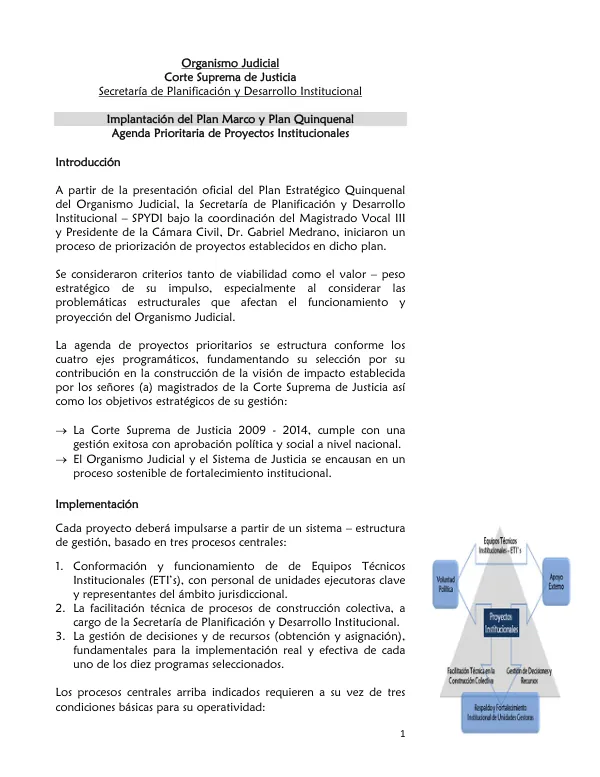
The prioritization process considered criteria of viability and strategic value, particularly in light of structural problems affecting the functioning and projection of the Organismo Judicial. The agenda of prioritized projects is structured around four programmatic axes, which underpin their selection based on their contribution to the construction of the established vision of impact by the magistrates of the Corte Suprema de Justicia and the strategic objectives of their management. The Corte Suprema de Justicia 2009-2014 successfully completed a management period with political and social approval at the national level, and the Organismo Judicial and the Justice System are aligned with a sustainable process of institutional strengthening. Implementation of the prioritized projects will be driven by a management system based on three central processes: the formation and functioning of Institutional Technical Teams (ETIs), the facilitation of collective construction processes by the Secretaría de Planificación y Desarrollo Institucional, and the management of decisions and resources, essential for the effective implementation of each of the ten selected programs. The central processes require three basic conditions for their operability: strategic political will, primarily from the Presidency of the Corte Suprema de Justicia and the General Management, with the involvement of the plenary and chambers; support for the executing units or managers of the processes, a generally neglected aspect that prevents the impetus from exceeding the period of management of the CSJ and even that of each President; and external support, mainly from cooperation and international financial organizations (donations and loans). Although the three conditions are required for the execution, fulfillment, and impact of the programs, the starting point should be the acquisition of resources, given the level of complexity and adversity revealed during the formulation of the Plan Marco (2009) and confirmed in the first two years of management of the current CSJ. Without resources, the programs are doomed to a short-term impetus with counterproductive effects, as any initiative that stops without achieving its goals (due to "lack of resources," a constant in public administration) results in waste of time, resources, and efforts, as well as undermining the confidence and credibility of the human teams in the process. From this premise, five initial implementation steps were defined: the initial statement expressing the general framework of the program, expressing its intention and course of action; the development of technical and financial proposals (project profiles) that allow the management of external resources; the management of financial, human, and technical resources from donations and loans; implementation, in accordance with the management system and the defined process flow; and evaluation-adjustment, systematization, and institutionalization (from the beginning of the impetus). The agenda prioritizes projects that address structural problems of the OJ, which require more than one administration to produce sustainable impacts. In the Plan Marco, it is evident that the internal political exercise is factually and legally trapped.
Related documents