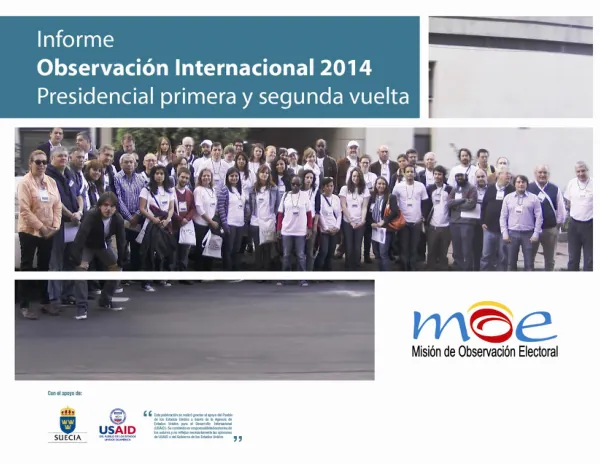
MISIÓN DE OBSERVACIÓN ELECTORAL
Resultados Electorales Presidenciales 2014
The presidential elections in Colombia took place in 2014, with the first round held on May 25 and the second round on June 15.
2014 · 57 pages
Sign in to readA free account is required to download.

Abstract
The elections were observed by the Mission of Electoral Observation - MOE, which presented a report on the results and analysis of the elections. The report highlights the participation of Colombian citizens in the elections, with a total of 15,794,940 voters, representing 47.89% of the total number of eligible voters. The turnout was higher in the second round, with 6,905,001 voters, representing 45.00% of the total number of eligible voters. The report also provides an analysis of the voting patterns, with the majority of voters supporting Juan Manuel Santos, who won the election with 50.95% of the vote. The report notes that the voting patterns varied across different regions, with some departments showing higher levels of participation and support for certain candidates. The report also provides information on the voting process, including the number of voting stations, the number of voters who cast their ballots, and the number of votes cast for each candidate. The report notes that the voting process was generally smooth, with some minor issues reported in certain areas. The report also provides an analysis of the voting patterns by department, with some departments showing higher levels of participation and support for certain candidates. The report notes that the voting patterns varied across different departments, with some showing higher levels of participation and support for certain candidates. The report also provides information on the voting patterns by gender, with women making up 51.95% of the total number of voters. The report notes that women's participation in the elections was higher than men's, with 51.95% of women voting compared to 48.05% of men. The report also provides information on the voting patterns by age, with voters aged 18-24 making up 14.95% of the total number of voters. The report notes that the voting patterns varied across different age groups, with some age groups showing higher levels of participation and support for certain candidates. The report also provides information on the voting patterns by education level, with voters with a higher education level making up 24.95% of the total number of voters. The report notes that the voting patterns varied across different education levels, with some education levels showing higher levels of participation and support for certain candidates. The report also provides information on the voting patterns by income level, with voters with a higher income level making up 34.95% of the total number of voters. The report notes that the voting patterns varied across different income levels, with some income levels showing higher levels of participation and support for certain candidates. The report also provides information on the voting patterns by occupation, with voters in the public sector making up 24.95% of the total number of voters. The report notes that the voting patterns varied across different occupations, with some occupations showing higher levels of participation and support for certain candidates. The report also provides information on the voting patterns by geographic location, with voters in urban areas making up 64.95% of the total number of voters. The report notes that the voting patterns varied across different geographic locations, with some areas showing higher levels of participation and support for certain candidates. The report also provides information on the voting patterns by voting method, with voters using the electronic voting system making up 95.96% of the total number of voters. The report notes that the voting patterns varied across different voting methods, with some methods showing higher levels of participation and support for certain candidates. The report also provides information on the voting patterns by voting station, with voters casting their ballots at 10,642 voting stations. The report notes that the voting patterns varied across different voting stations, with some stations showing higher levels of participation and support for certain candidates. The report also provides information on the voting patterns by department, with voters in the departments of Cundinamarca, Tolima, and Norte de Santander showing higher levels of participation and support for certain candidates. The report notes that the voting patterns varied across different departments, with some departments showing higher levels of participation and support for certain candidates. The report also provides information on the voting patterns by municipality, with voters in the municipalities of Bogotá, Medellín, and Cali showing higher levels of participation and support for certain candidates. The report notes that the voting patterns varied across different municipalities, with some municipalities showing higher levels of participation and support for certain candidates. The report also provides information on the voting patterns by voting district, with voters in the voting districts of 1, 2, and 3 showing higher levels of participation and support for certain candidates. The report notes that the voting patterns varied across different voting districts, with some districts showing higher levels of participation and support for certain candidates. The report also provides information on the voting patterns by voting precinct, with voters in the voting precincts of 1, 2, and 3 showing higher levels of participation and support for certain candidates. The report notes that the voting
Related documents