THE WORLD BANK
Creating a Sustainable Food Future: The Great Balancing Act
The world faces a significant challenge in feeding more than 9 billion people by 2050 while advancing economic development and reducing pressure on the environment.
2013 · 16 pages
Sign in to readA free account is required to download.
Abstract
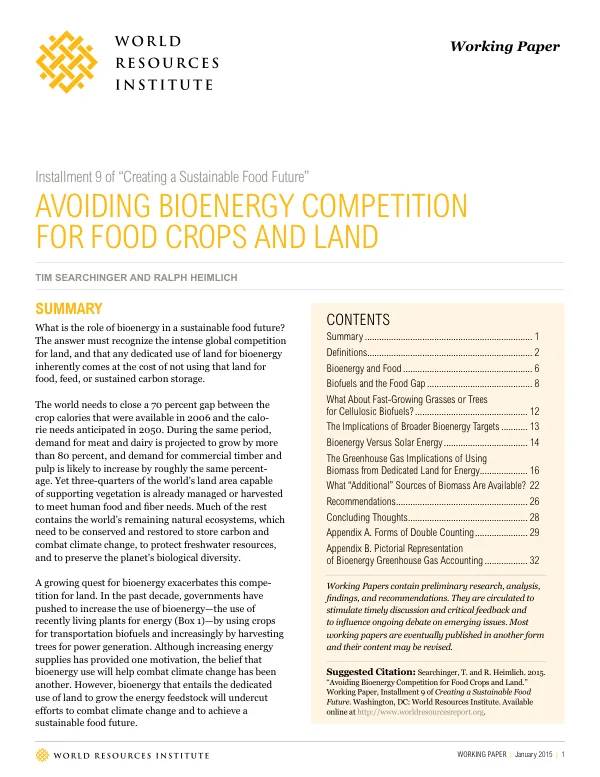
This challenge requires a "great balancing act" of three needs: closing the gap between the food available today and that needed by 2050, contributing to inclusive economic and social development through agriculture, and reducing agriculture's impact on the environment and natural resources. The first need is to close the gap between the food available today and that needed by 2050. The global population is projected to grow from 7 billion in 2012 to 9.3 billion by 2050, with at least 3 billion more people likely to enter the global middle class by 2030. These individuals will demand more resource-intensive foods, such as meats and vegetable oils, which will increase the demand for food calories by about 60 percent from 2006 levels. Approximately 870 million of the world's poorest people remain undernourished even today, and without successful measures to restrain food demand growth by the world's more affluent, available worldwide food calories will need to increase to meet everyone's needs. The second need is for agriculture to contribute to inclusive economic and social development. Agriculture directly accounts for approximately 3 percent of global gross domestic product (GDP), but it employs more than 2 billion people around the world, at least part-time. Many of the world's poorest people are farmers or farm laborers, and growth of the agricultural sector can reduce poverty more effectively than growth arising from other economic sectors. Agricultural growth can also generate benefits for women, who make up 41 percent of the agricultural workforce worldwide and the majority of agricultural workers in South Asia and sub-Saharan Africa. The third need is to reduce agriculture's impact on the environment and natural resources. Three environmental impacts are especially important: ecosystems, climate, and water. Agriculture has been the primary cause of ecosystem loss and degradation since its invention 8,000-10,000 years ago, and it continues to expand and drive tropical deforestation, the conversion of carbon-rich peatlands, and associated impacts on biodiversity. Agriculture accounted for approximately 24 percent of global greenhouse gas emissions in 2010, and it accounts for 70 percent of all freshwater withdrawn from rivers, lakes, and aquifers, and for 80 to 90 percent of such water that is actually consumed and not returned. Failure to address these environmental impacts would hamper food production in coming decades. Land degradation affects approximately 20 percent of the world's cultivated areas, and forest loss could lead to regional drying and warming, which could increase stress on agriculture. Rising sea levels will reduce cropland productivity and viable cropland area in coastal regions, and many crop-generating regions already struggle with significant water stress, leading to declines in crop production. The World Resources Report (WRR) provides decision-makers with analysis and insight on major issues at the nexus of development and the environment. The WRR is a unique long-term partnership between the World Resources Institute, the United Nations Development Programme, the United Nations Environment Programme, and The World Bank. This year, L'Institut National de la Recherche Agronomique (INRA) and Le Centre de Coopération Internationale en Recherche Agronomique pour le Développement (CIRAD) have joined as analytical collaborators. The WRR is releasing a series of working paper installments, including "The Great Balancing Act," which frames the series by exploring the scope of the challenge and proposing a menu of potential solutions. Each installment will analyze a menu item from the proposed "menu for a sustainable food future" and recommend policies and other measures for implementation. The series will not cover all menu items, but it will consider questions such as what the menu item is, how big an impact it could make, where it might be most applicable, and what obstacles need to be overcome.
Related documents