USAID DEC
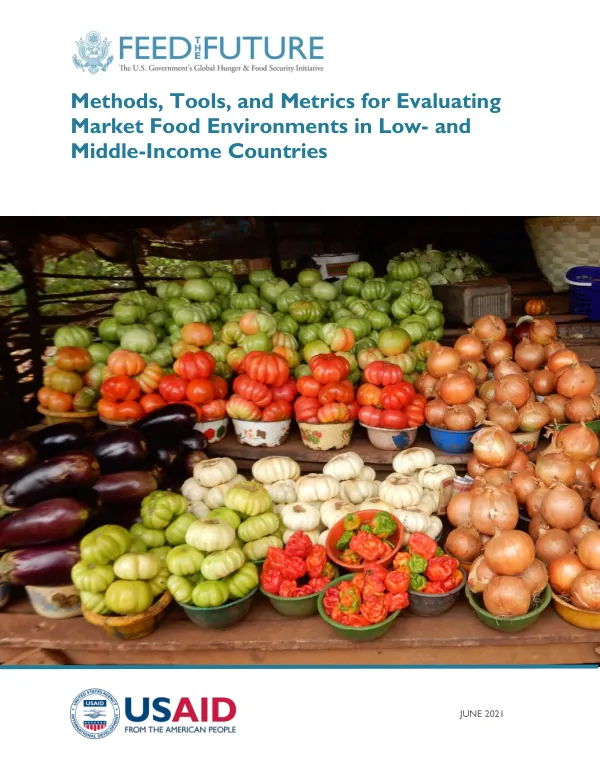
Methods, Tools, and Metrics for Evaluating Market Food Environments in Low- and Middle-Income Countries
Sign inJSI RESEARCH & TRAINING INSTITUTE, INC
Methods, Tools, and Metrics for Evaluating Market Food Environments in Low- and Middle-Income Countries
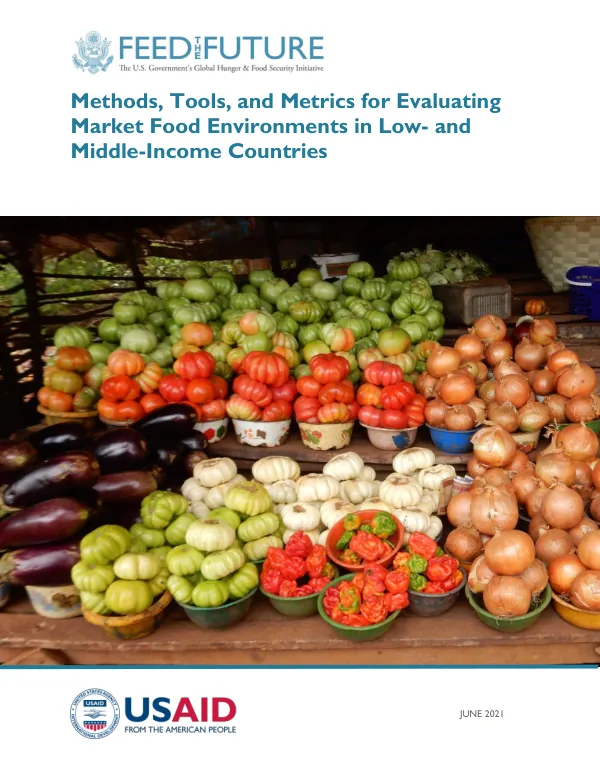
Market food environments in low- and middle-income countries (LMICs) play a crucial role in shaping consumer choices and influencing nutrition and health outcomes.
2021 · 22 pages
Sign in to readA free account is required to download.
Abstract
The ability of consumers to access, afford, and choose healthy, diverse, and sustainable diets is vital for improving nutrition and health outcomes. In LMICs, household diets increasingly comprise purchased foods, with poor households purchasing 48 percent of their food and middle-class households purchasing approximately 60-80 percent. A market food environment is composed of various domains and dimensions, including cultivated food environments, formal and informal market food environments, marketing and regulation, and vendor and product characteristics. The cultivated food environment encompasses fields, orchards, closed pastures, gardens, and aquaculture from which consumers directly procure food. Formal market food environments are regulated through formal governance structures, while informal market food environments are often not regulated and include wet markets, street vendors, kiosks, and mobile vendors. To evaluate market food environments in LMICs, a comprehensive approach is necessary. This approach involves a landscape assessment, ranking exercise with internal panel, and survey with external experts. The landscape assessment provides an overview of the market food environment, while the ranking exercise and survey help identify key indicators and metrics for evaluation. The evidence-based priority list is developed based on the findings from these activities, and the most suitable methods, tools, and metrics for evaluating market food environments in LMICs are identified. The report highlights the importance of considering accessibility, affordability, availability, convenience, desirability, and sustainability when evaluating market food environments. Accessibility refers to physical and temporal access by individuals to specific foods or food vendors in markets, while affordability is the interaction between prices and individual purchasing power. Availability is the presence of a specific food or food groups in a given place, and convenience is the time cost of obtaining, preparing, and consuming a specific food item or group of food items. The report also emphasizes the need for a systems approach to evaluating market food environments, which involves considering the interactions between different components of the food system. This approach recognizes that market food environments are shaped by a complex array of factors, including policy, economic, social, and environmental factors. By taking a systems approach, it is possible to identify the key drivers of market food environments and develop effective interventions to improve nutrition and health outcomes. In conclusion, evaluating market food environments in LMICs requires a comprehensive and systems-based approach. This approach involves a landscape assessment, ranking exercise, and survey, as well as consideration of accessibility, affordability, availability, convenience, desirability, and sustainability. By identifying the most suitable methods, tools, and metrics for evaluation, it is possible to develop effective interventions to improve nutrition and health outcomes in LMICs. The report provides a framework for evaluating market food environments in LMICs, which can be used by policymakers, researchers, and practitioners to inform decision-making and program development. The framework emphasizes the need for a systems approach and highlights the importance of considering the interactions between different components of the food system. By using this framework, it is possible to develop effective interventions to improve nutrition and health outcomes in LMICs and contribute to the achievement of the Sustainable Development Goals (SDGs). The report also highlights the need for further research and development of new methods, tools, and metrics for evaluating market food environments in LMICs. This research should focus on developing a more comprehensive understanding of the complex interactions between different components of the food system and identifying effective interventions to improve nutrition and health outcomes. By continuing to develop and refine the framework for evaluating market food environments, it is possible to make significant progress towards improving nutrition and health outcomes in LMICs.