USAID DEC
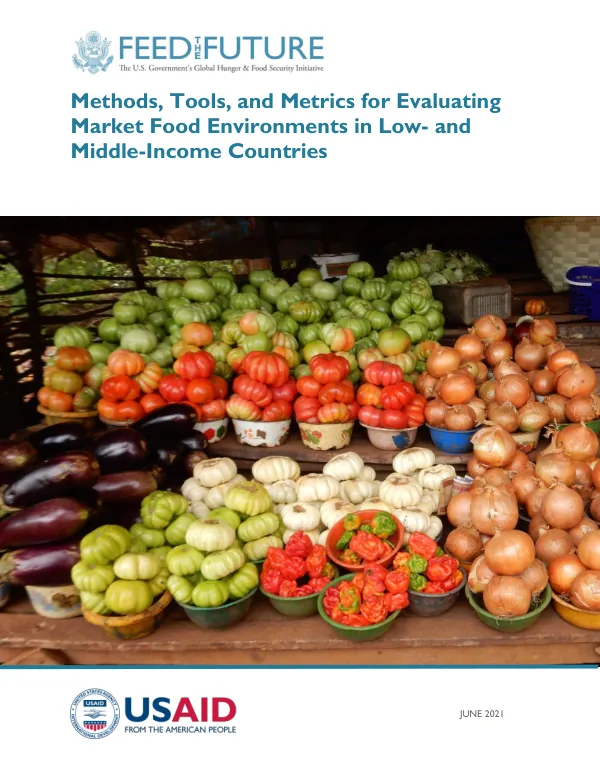
Methods, Tools, and Metrics for Evaluating Market Food Environments in Low- and Middle-Income Countries
Sign inJSI RESEARCH & TRAINING INSTITUTE, INC
Methods, Tools, and Metrics for Evaluating Market Food Environments in Low- and Middle-Income Countries
Market food environments in low- and middle-income countries (LMICs) play a crucial role in shaping consumer choices and influencing nutrition and health outcomes.
2021 · 22 pages
Sign in to readA free account is required to download.
Abstract
The ability of consumers to access, afford, and choose healthy, diverse, and sustainable diets is vital for improving nutrition and health outcomes. In LMICs, household diets increasingly comprise purchased foods, with poor households purchasing 48 percent of their food and middle-class households purchasing approximately 60-80 percent. A comprehensive understanding of market food environments is essential for designing effective nutrition interventions. Market food environments encompass various domains, including cultivated food environments, formal and informal market food environments, and wild food environments. These domains are characterized by distinct features, such as accessibility, affordability, availability, convenience, desirability, marketing and regulation, price, sustainability, vendor and product characteristics, and wild food environment. To evaluate market food environments in LMICs, a systematic approach is necessary. This involves conducting a landscape assessment, ranking exercise with internal panel, and survey with external experts. The landscape assessment provides an overview of the market food environment, while the ranking exercise and survey help identify key indicators and metrics for evaluation. The evidence-based priority list, developed through these activities, serves as a guide for selecting the most suitable methods, tools, and metrics for evaluating market food environments in LMICs. The report highlights the importance of considering the following methods, tools, and metrics for evaluating market food environments in LMICs: accessibility, affordability, availability, convenience, desirability, marketing and regulation, price, sustainability, vendor and product characteristics, and wild food environment. These indicators are essential for understanding the complex dynamics of market food environments and designing effective nutrition interventions. The discussion and recommendations section of the report emphasizes the need for a multi-faceted approach to evaluating market food environments. This includes considering the social, economic, and environmental aspects of market food environments and using a combination of quantitative and qualitative methods. The report also highlights the importance of engaging with stakeholders, including consumers, vendors, and policymakers, to ensure that evaluation efforts are relevant and effective. In conclusion, the report provides a comprehensive framework for evaluating market food environments in LMICs. By considering the complex dynamics of market food environments and using a systematic approach to evaluation, policymakers and practitioners can design effective nutrition interventions that improve nutrition and health outcomes. The report's findings and recommendations serve as a valuable resource for stakeholders seeking to improve market food environments and promote healthy diets in LMICs.