USAID DEC
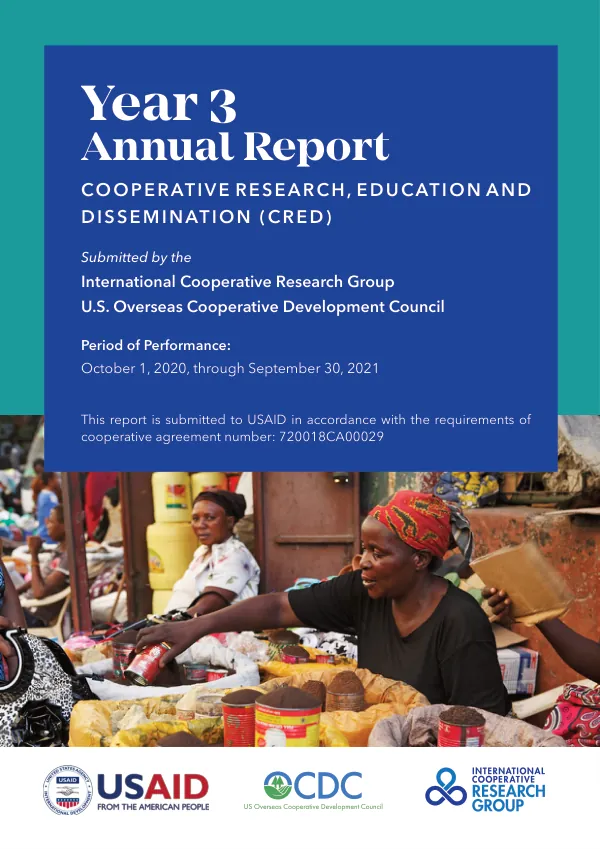
CRED Year 3 Annual Report
The Cooperative Research, Education, and Dissemination (CRED) activity, implemented by the International Cooperative Research Group (ICRG), marks the halfway point of its period of performance, spanning from October 1, 2020, to September 30, 2021.
2021 · 24 pages
Sign in to readA free account is required to download.
Abstract
The CRED activity is a cooperative agreement between the U.S. Overseas Cooperative Development Council (OCDC) and the United States Agency for International Development (USAID). The ICRG conducted an ambitious, academically rigorous multi-country study, What Difference Do Cooperatives Make? (WDDCM), which provides evidence that members of cooperatives are less likely to be poor or very poor and more likely to have above-average incomes compared to non-members and the population at large. The study demonstrates a measurable "cooperative difference" and has implications for greater agency for women, provision of a pathway to the middle class, equalizing access to healthcare, and other crucial services. The WDDCM project served as an engagement platform with senior host country policymakers, cooperative, civil society, and academic leaders, cooperative members, and Cooperative Development Organizations (CDOs). The ICRG's strategic use of CRED's research, learning, and dissemination activities builds upon the lessons learned from WDDCM and other initiatives during this program year. The CRED activity is organized around three major themes: Cooperatives in the Economy, Cooperative Diversity and Inclusion, and Cooperative Innovation and Efficiency. These themes place CRED and cooperative development within the larger framework of emerging international development challenges and opportunities. The ICRG conducts original, independent, academically rigorous research to fill knowledge gaps and disseminate data-driven results to increase the positive impact of cooperative development and its uptake by governments, donors, and others. The research has two main goals: providing action-oriented evidence to inform policymakers and improving program design and implementation by CDOs and other implementers. The core three pillars of CRED's strategy consist of mutually reinforcing activities: research, education/learning, and dissemination. The strategy is embodied in three approaches: developing robust evidence and creating new knowledge through rigorous research, working with OCDC members and other global and USAID-assisted country stakeholders, and disseminating key research outcomes to a range of stakeholders. The ICRG's research is characterized by academic rigor, practical applications, and cooperative excellence. The research outcomes are disseminated in both "practice-friendly" and "policy-friendly" formats to inform local, national, and international strategies, bridge the outcomes to action, and increase the uptake of cooperative development. The CRED activity has made significant progress in meeting its objectives of increasing impact and uptake of international cooperative development. The ICRG has concluded the organization's first major policy-facing research activity and initiated a continuing dissemination program. The research has successfully reached senior levels of government and the cooperative sector, and the ICRG has gained insight into the power and potential of data and research in the international development space. The ICRG has also learned valuable lessons from WDDCM and other initiatives during this program year. The organization has demonstrated the importance of engaged research in promoting local ownership and evidence-informed change. The ICRG has created strategic partnerships, nuanced its engagement strategy, and directly impacted policy through its research and dissemination activities. The CRED activity has a strong focus on women's economic empowerment, with a subtheme dedicated to this area. The research has shown that women-headed households have higher adoption rates for cooperative practices, and the ICRG has worked to promote women's economic empowerment through its research and dissemination activities. The ICRG has also explored the impact and potential of cooperatives as an approach and strategy for economic development, including during crises, diverse economic sectors, and for diverse members. The research has demonstrated the importance of cooperatives in promoting broad-based economic development, resilience, and women's economic empowerment. The CRED activity has a strong focus on innovation and efficiency, with a subtheme dedicated to this area. The research has explored the use of technology and enabling environments to promote cooperative development and has demonstrated the importance of cooperative innovation and efficiency in promoting economic development. The ICRG has worked with a range of stakeholders, including OCDC members, CDOs, and senior host country policymakers, to promote cooperative development and increase its uptake. The organization has also engaged in outreach and dissemination activities to promote the research outcomes and increase their impact. Overall, the CRED activity has made significant progress in meeting its objectives and has demonstrated the importance of cooperative development in promoting economic development, resilience, and women's economic empowerment. The ICRG's research and dissemination activities have had a positive impact on the cooperative sector and have promoted the uptake of cooperative development by governments, donors, and others.