PALLADIUM INTERNATIONAL, LLC
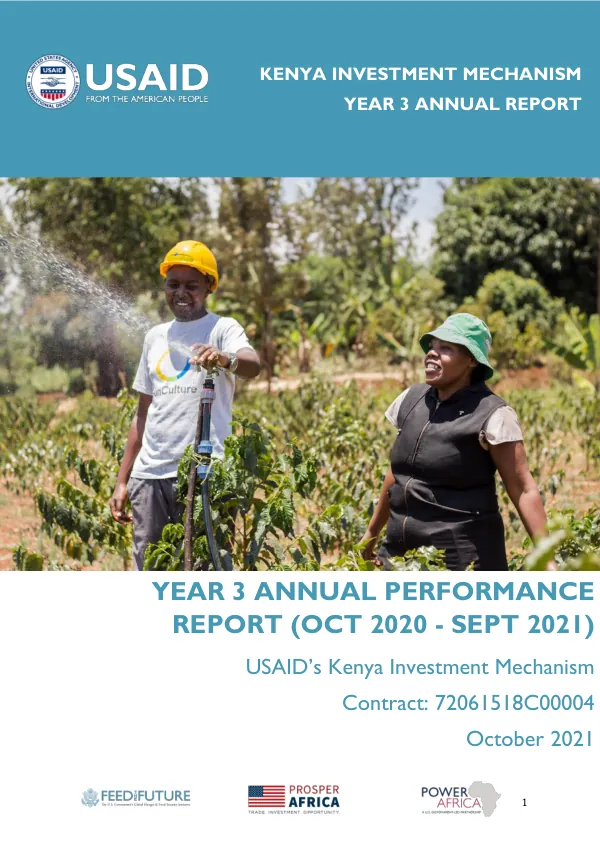
Year 3 Annual Report: USAID's Kenya Investment Mechanism
The Kenya Investment Mechanism (KIM) mobilized $154 million for enterprises across various sectors in Year 3, surpassing its annual target by $72 million.
2021 · 67 pages
Sign in to readA free account is required to download.
Abstract
This achievement is attributed to the team's agility and ability to adapt program strategies in response to changing market demands and operating context. KIM's partner business advisory service providers (BASPs) facilitated $48.8 million in finance and investments, while financial institutions (FIs) disbursed $105 million. The team identified more than 250 businesses for investment opportunities worth nearly $450 million, with over half of these businesses signing engagement letters to mobilize over $280 million in capital. Cumulatively since the start of the program, KIM has mobilized $275.4 million for 53,941 enterprises. This includes $118.9 million by BASPs and $152.2 million by FIs participating in KIM's pay-for-results (P4R) program, as well as an additional $5 million mobilized through KIM's direct facilitation. Women-owned enterprises accessed $42.5 million in financing, representing 15% of total capital mobilized, while youth-owned enterprises received $11.0 million, accounting for 4% of total capital mobilized. KIM's strategy to target major commercial banks paid off with the onboarding of Equity Bank, KCB Bank, and Family Bank. These banks significantly contributed to the increased flow of capital to enterprises in the targeted sectors. Despite the challenging lending environment precipitated by the COVID-19 pandemic, KIM's FI network increased its engagement with the agriculture sector. As of December 2020, partner FIs' agricultural loan portfolio had nearly doubled from 3.6% in December 2019 to 7.1%. KIM continued to focus on supporting the development of a business enabling environment for investments. The team worked closely with the Government of Kenya to strengthen the regulatory framework and improve the ease of doing business. KIM also collaborated with the Kenya Private Sector Alliance (KEPSA) to promote private sector development and investment in key sectors such as agriculture, manufacturing, and tourism. In addition to mobilizing capital, KIM implemented various initiatives to support the growth of micro, small, and medium enterprises (MSMEs). The team provided technical assistance to MSMEs, facilitated access to finance, and promoted market linkages. KIM also worked with the Kenya Commercial Bank (KCB) to develop a credit guarantee scheme for MSMEs, which helped to increase access to finance for this critical segment of the economy. Overall, KIM's efforts in Year 3 contributed to the growth and development of the Kenyan economy, with a focus on supporting the development of a business enabling environment for investments and promoting the growth of MSMEs. The team's ability to adapt to changing market demands and operating context enabled KIM to achieve its goals and make a positive impact on the lives of Kenyans.
Related documents