CHEMONICS
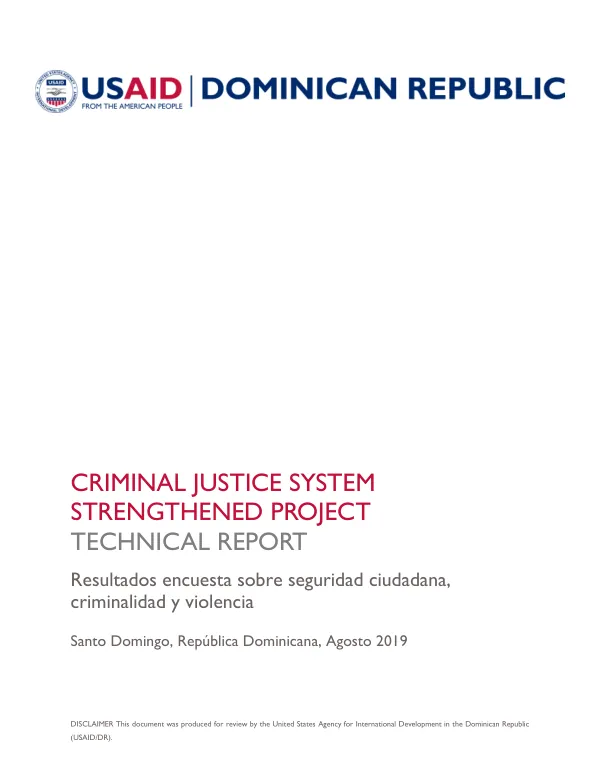
Criminal Justice System Strengthened Project Technical Report
The Criminal Justice System Strengthened Project in the Dominican Republic aimed to assess the security situation, crime, and violence in the country.
2019 · 144 pages
Sign in to readA free account is required to download.
Abstract
The project was conducted in five districts of the Duarte Corridor, including Santo Domingo de Guzmán, Santo Domingo Oeste, Santiago de los Caballeros, San Francisco de Macorís, and San Felipe de Puerto Plata. A total of 5,542 households were surveyed, with a response rate of 95%. The survey aimed to gather information on various aspects of security, crime, and violence, including the perception of the police, crime rates, and victimization. The results showed that 71% of respondents reported feeling insecure in their neighborhoods, while 64% believed that the police were not effective in controlling crime. Additionally, 55% of respondents reported experiencing some form of violence in the past year, with 22% experiencing physical violence. The survey also found that 45% of respondents believed that the police were corrupt, while 35% reported having been victims of police abuse. Furthermore, 62% of respondents reported that they had not reported a crime to the police in the past year, citing fear of retaliation or lack of trust in the police. In terms of crime rates, the survey found that 55% of respondents reported knowing someone who had been a victim of crime, while 45% reported knowing someone who had been a victim of violence. The most common types of crime reported were theft, robbery, and assault. The survey also gathered information on the perception of the police and other institutions, including the courts, the prosecutor's office, and the military. The results showed that 55% of respondents reported having confidence in the courts, while 45% reported having confidence in the prosecutor's office. However, only 25% of respondents reported having confidence in the police. In terms of community participation, the survey found that 62% of respondents reported participating in community activities, while 55% reported participating in neighborhood watch programs. However, 45% of respondents reported feeling that their community was not safe, while 35% reported feeling that their neighborhood was not secure. The survey also gathered information on the perception of crime and violence in the community, including the level of violence, the probability of being a victim of crime, and the level of security in the neighborhood. The results showed that 71% of respondents reported feeling that their neighborhood was not secure, while 55% reported feeling that their community was not safe. In terms of violence in schools, the survey found that 45% of respondents reported knowing someone who had been a victim of violence in school, while 35% reported knowing someone who had been a victim of bullying. The most common types of violence reported were physical violence, verbal abuse, and intimidation. The survey also gathered information on gender-based violence and domestic violence, including the prevalence of domestic violence, the types of violence experienced, and the level of fear experienced by victims. The results showed that 55% of respondents reported knowing someone who had been a victim of domestic violence, while 45% reported knowing someone who had been a victim of physical violence. Overall, the survey found that the Dominican Republic faces significant challenges in terms of security, crime, and violence. The results highlight the need for improved policing, increased community participation, and enhanced support for victims of crime and violence.
Related documents