CATHOLIC RELIEF SERVICES ORGANIZATION
Crop Availability and Market Analysis in Ethiopia
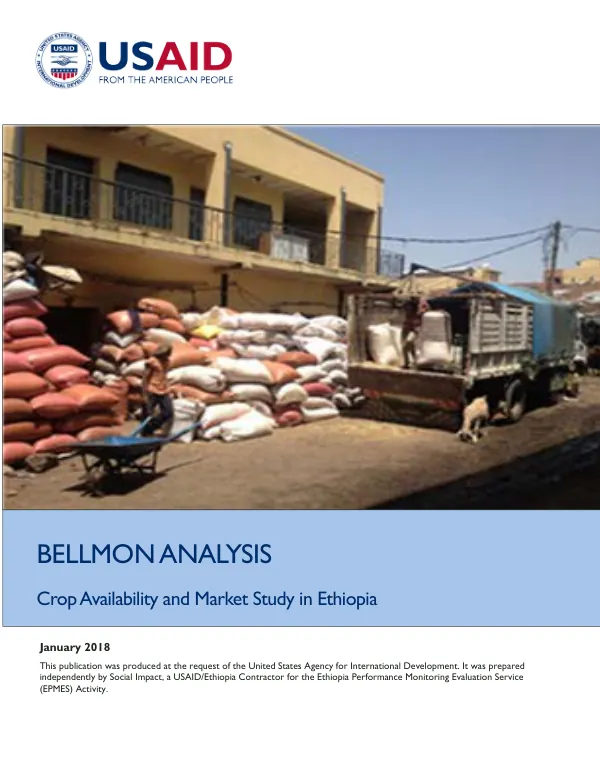
Crop Availability and Market Analysis in Ethiopia was conducted in January 2018 by Social Impact, a USAID/Ethiopia Contractor for the Ethiopia Performance Monitoring and Evaluation Service (EPMES) Activity.
2018 · 148 pages
Sign in to readA free account is required to download.
Abstract
The study aimed to determine whether direct cash transfer and distribution of U.S. agricultural commodities provided for use in Ethiopia during FY18 through Title II meet the criteria set forth in the Bellmon Amendment. The analysis examined food availability and demand in the country and potential impact of food distribution on local markets in Oromia, Amhara, Southern Nations, Nationalities and People's (SNNP), Tigray regions, and Dire Dawa city administration. The report analyzed interactions between beneficiaries and surrounding markets, market dynamics, local traders' capabilities to cope with increased demand, and households' access to a diversified diet. Quantitative analyses showed historical trends, commodity flows, price volatility, and qualitative data from focus groups with farmers, key informant interviews with other stakeholders, and secondary data. Results indicated that food supply in 2017/18 was approximately 31.45 million metric tons. Food supply would be adequate to meet minimum energy requirements only if imports of grains reached 987,300 metric tons; otherwise, it would be inadequate. Cereal availability in Ethiopia was low in both surplus and deficit areas, causing prices to increase throughout the country. Short-term and short-lived inflationary pressures were evident in the market immediately after a cash transfer. Ports, storage, and inland transportation seemed adequate for the transportation and storage of food aid commodities. There was no evidence that either a Title II food distribution or cash transfer would have a substantial negative effect on the marketing and production of grains in Ethiopia in 2017/18. The study's findings were based on a comprehensive analysis of food supply and demand, market dynamics, and the impact of food aid on local markets. The study's methodology involved a combination of quantitative and qualitative data collection and analysis methods. The study design and approach were based on a mixed-methods research design, which included both quantitative and qualitative data collection and analysis. The data sources included focus groups with farmers, key informant interviews with other stakeholders, and secondary data. The study area consisted of four regions in Ethiopia: Oromia, Amhara, Southern Nations, Nationalities and People's (SNNP), and Tigray. The study objectives were to determine the impact of food aid on local markets and to assess the adequacy of food supply in Ethiopia in 2017/18. The study's findings have implications for food aid policy and programming in Ethiopia. The study's results suggest that food aid can be an effective tool for addressing food insecurity in Ethiopia, particularly in areas where food supply is inadequate. However, the study also highlights the need for careful planning and implementation of food aid programs to avoid negative impacts on local markets. The study's methodology and findings provide a comprehensive understanding of the food availability and market situation in Ethiopia in 2017/18. The study's results can inform food aid policy and programming in Ethiopia and provide a basis for future research on food security and market dynamics in the country.
Related documents