CARE
FY 2019 Annual Results Report
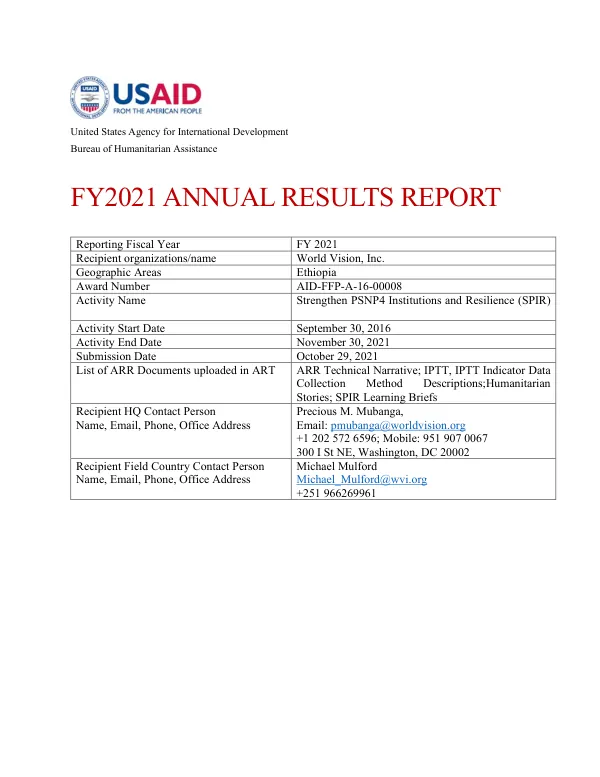
The Strengthen PSNP4 Institutions and Resilience (SPIR) Resilience Food Security Activity (RFSA) implemented by World Vision and its partners CARE and ORDA enhanced livelihoods, increased resilience against shocks, and improved food security and nutrition for rural households that were vulnerable to food insecurity in Ethiopia.
24 pages
Sign in to readA free account is required to download.
Abstract
The activity focused on four purpose areas: increased income, productive assets, and equitable access to nutritious food for vulnerable women, men, and youth; improved nutritional status of children under 2 years of age, PLW, and adolescent girls; increased female empowerment, youth empowerment, and gender equity; and strengthened ability of women, men, and communities to mitigate, adapt to, and recover from human-caused and natural shocks. SPIR implemented a multisectoral package of interventions to improve outcomes in several domains, including livelihoods, food security, child nutrition, women's empowerment, mental health, and intimate partner violence. Despite the impact of the COVID-19 pandemic, civil conflict in Tigray, and regional desert locust infestations, SPIR made significant progress toward achieving its intended goals and outcomes. The activity reached 497,525 participants, with 46,223 earning income from the sales of value chain commodities engaged in through SPIR support, totaling approximately $5,161,957.42. SPIR's interventions led to several positive changes, including improved access to financial services, increased income for those engaged in value chain activities, and changes in knowledge, behavior, and practices of nutrition, hygiene, and sanitation. The activity also contributed to community resilience through the rehabilitation of degraded land using various soil and water conservation practices, such as farmer-managed natural regeneration (FMNR). Additionally, SPIR observed increased health-seeking behavior by PSNP households and saw men change their behaviors and begin supporting their wives through household chores. In terms of agricultural livelihoods, SPIR provided technical support and capacity-building training for 21,628 program participants who engaged in shoat fattening value chain activities. As a result of SPIR interventions, the conventional fattening period was shortened from 1+ years to 3-4 months. During the year, a total of 82,857 shoats were fattened and 58,910 shoats sold by program participants. Furthermore, SPIR achieved significant achievements in the area of Natural Resource Management practices, with more people adopting soil and water conservation practices in their own farmlands and more hectares of land being rehabilitated (37% of the degraded communal land was rehabilitated compared to the expected 25% for this fiscal year). SPIR's interventions also led to improved nutritional status of children under 2 years of age, PLW, and adolescent girls. Parents/caregivers received social and behavior change (SBC) interventions that promoted essential infant and young child feeding (IYCF) behaviors, and 97% of referred children with acute malnutrition cases were treated, showing enhanced SAM and MAM treatment. Additionally, SPIR provided access to water supply schemes through its interventions, reaching 28,630 participants during the reporting period. Overall, SPIR's interventions have led to many positive changes, despite the many challenges faced during FY21. The activity has made significant progress toward achieving its intended goals and outcomes, and its interventions have contributed to community resilience, improved livelihoods, and increased food security and nutrition for rural households in Ethiopia.
Related documents