NORC AT THE UNIVERSITY OF CHICAGO
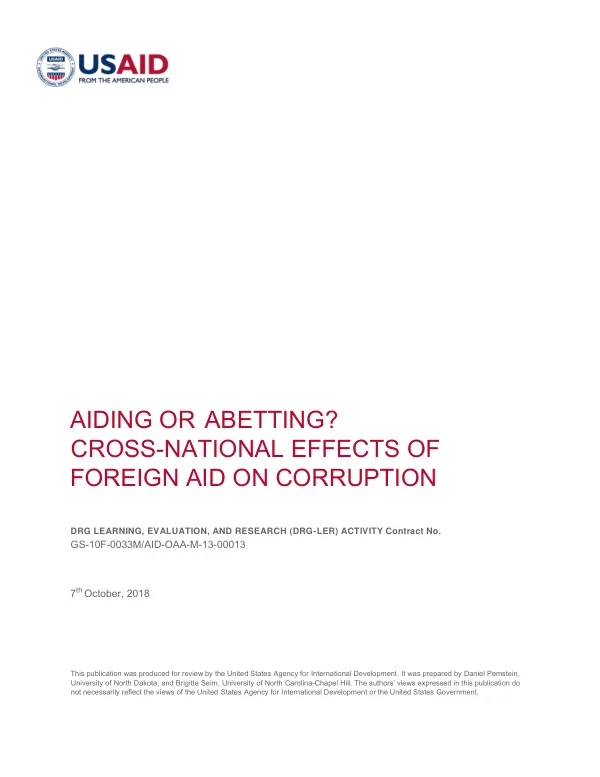
Cross-National Effects of Foreign Aid on Corruption
Foreign aid has been a topic of debate among scholars and policymakers regarding its impact on corruption in recipient countries.
2018 · 20 pages
Sign in to readA free account is required to download.
Abstract
The literature is split between those who argue that aid fosters corruption and those who claim it reduces corruption. This study uses newly available data to examine the effects of foreign aid on various forms of government corruption. The study uses data from the Varieties of Democracy project and AidData to examine how corruption levels change after countries experience increases in total, anti-corruption, legal and judicial, media, and civil society aid. The analysis finds that aid acts as a resource "curse" and corruption increases with aid, especially within the legislative and judicial domains. Legal and judicial aid is particularly associated with increases in corruption. The results are sensitive to how the relationship between aid and corruption is modeled. While there is a significant relationship between aid levels and corruption levels over time, there appears to be no significant relationship between aid shocks and corruption levels. The study suggests that foreign aid may expand avenues for corruption, particularly in the judiciary and legislative branches, even when it is specifically intended to improve accountability. The study also examines the relationship between aid and corruption in different sectors. The results show that aid to the judiciary is associated with increased corruption, but other types of aid intended to reduce corruption or improve accountability do not covary with corruption levels. The study's findings provide expanded insight on the downstream effects of foreign aid on recipient countries. The literature on foreign aid and corruption is divided between those who argue that aid fosters corruption and those who claim it reduces corruption. Some studies argue that aid makes recipient countries dependent on inflows, creating a "curse" that facilitates corruption. Others argue that aid can reduce corruption by bolstering legal institutions and strengthening recipient countries' civil society and media sectors. The study contributes to this literature by providing a robust test adjudicating between two competing hypotheses: the resource curse hypothesis, which suggests that foreign aid increases corruption, and the international involvement hypothesis, which suggests that foreign aid decreases corruption. The study also examines the relationship between aid and corruption in different sectors, including the bureaucracy, judiciary, and civil society. The study's findings have implications for policymakers and scholars seeking to understand the effects of foreign aid on corruption in recipient countries. The results suggest that foreign aid may have unintended consequences, such as increasing corruption in the judiciary and legislative branches, and that policymakers should be cautious when designing aid programs intended to reduce corruption. The study uses a combination of regression analysis and synthetic control methods to examine the relationship between aid and corruption. The analysis is based on data from AidData and the Varieties of Democracy project, which provide comprehensive coverage of foreign aid and corruption indicators. The study's results are sensitive to how the relationship between aid and corruption is modeled. While there is a significant relationship between aid levels and corruption levels over time, there appears to be no significant relationship between aid shocks and corruption levels. The study suggests that foreign aid may have a complex and nuanced impact on corruption, and that policymakers should be cautious when designing aid programs intended to reduce corruption.