CONDESAN
Cuencas Climáticamente Resilientes: Chinchiná, Colombia y Mantaro, Perú
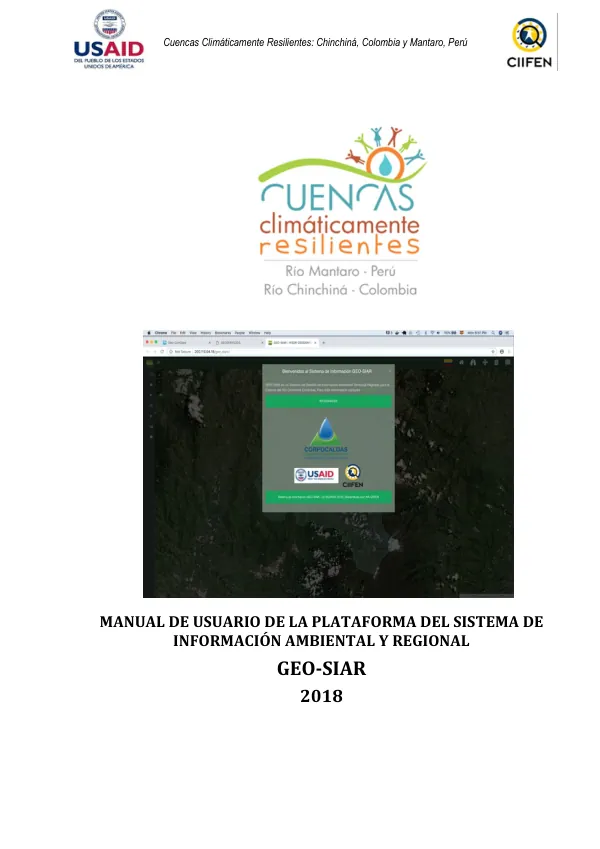
The project Cuencas Climáticamente Resilientes, executed by the CIIFEN (Centro Internacional para la Investigación del Fenómeno de El Niño) with funding from USAID, aims to reduce vulnerability and increase resilience to climate change and variability in the Chinchiná River basin in Colombia and the Mantaro River basin in Peru.
2018 · 16 pages
Sign in to readA free account is required to download.
Abstract
The project pursues three specific objectives: 1. Identifying, with greater detail and precision, the regional expression of climate variability and change, associated impacts, and hydroclimatic risks in the areas of intervention, as well as global vulnerability levels of the basin; 2. Strengthening the capacities of regional, local governments, and other actors in the areas of study to incorporate climate variability and change criteria in planning processes and instruments; 3. Strengthening local meteorological services in the basins to support risk management by extreme phases of climate variability and change. To achieve these objectives, the project has implemented various activities, including the exchange of experiences between the two countries. The exchange aimed to contribute to the process of knowledge management and incorporation of knowledge in territorial decision-making through the exchange of experiences carried out in the hydrographic basins of the project in Peru and Colombia. The exchange involved delegations from the Chinchiná River basin in Colombia and the Mantaro River basin in Peru, including representatives from the Council of the Chinchiná River basin and the Authority of the department Corpocaldas. The exchange focused on three main topics: - Instrumental financial mechanisms for water management and adaptation to climate change and variability; - Traditional practices and technologies for local water management and adaptation to climate change and variability, and ecosystem recovery; - Intercultural dialogues as a basis for the construction of effective water governance models. The exchange allowed for the identification of common problems, the sharing of experiences, and the generation of interesting spaces for discussion and the exchange of ideas. The exchange also contributed to the strengthening of local capacities and the improvement of knowledge management processes. The project has also implemented various activities to support the exchange of experiences, including the visit to the SUNASS (Superintendence of National Services of Sanitation) in Peru, where the framework of the mechanisms of retribution by ecosystem services was presented. The main differences between the Peruvian and Colombian cases were highlighted, including the type of norm, the source of resources for payment or retribution, and the entities responsible for executing the projects. The project has also supported the development of various instances, such as the Council of the Cuenca or the Council of Water Resources, and has participated in and supported initiatives for the design and implementation of financial and technical instruments for adaptation, such as water funds, payment schemes for environmental services, and ecosystem-based adaptation measures.