USAID DEC
Recuperación del Servicio Ecosistémico de Regulación Hídrica en la Comunidad de Carampoma-Huarochirí-Lima
Sign inCONDESAN
Recuperación del Servicio Ecosistémico de Regulación Hídrica en la Comunidad de Carampoma-Huarochirí-Lima
The Microcuenca de Milloc project aims to recover the ecosystem service of water regulation in the Carampoma-Huarochirí-Lima region.
2022 · 1 pages
Sign in to readA free account is required to download.
Abstract
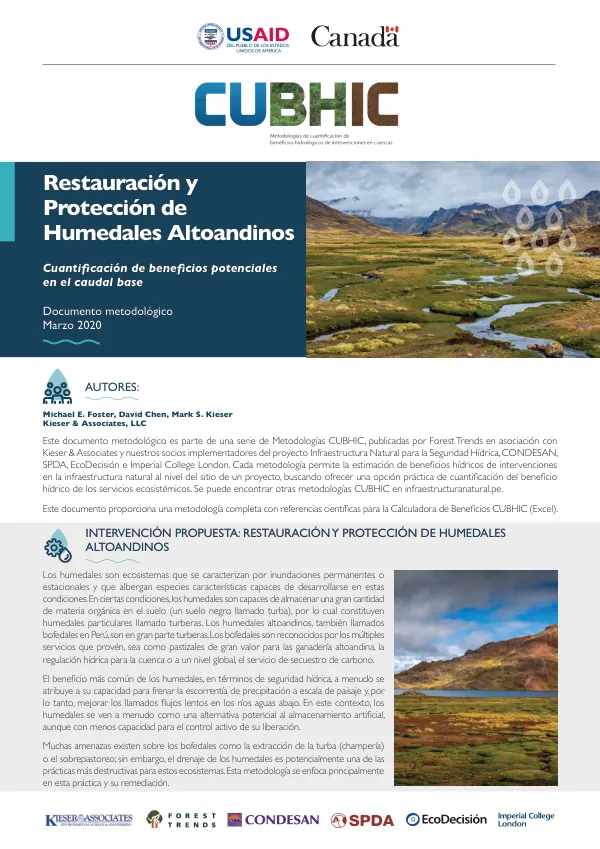
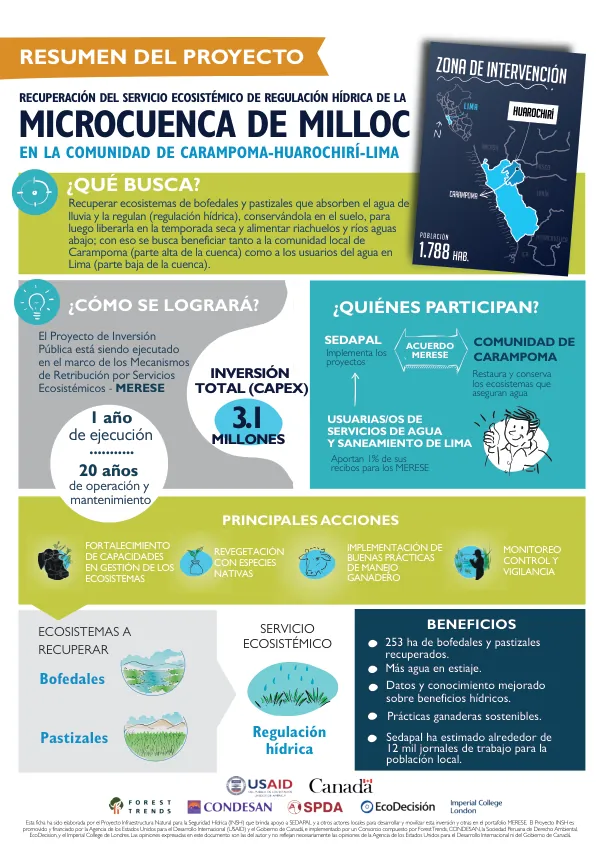
The project focuses on restoring and conserving bofedales and pastizales, which absorb and regulate rainfall, conserving water in the soil and releasing it during the dry season to feed rivers and streams downstream. This initiative benefits both the local community of Carampoma and water users in Lima. The project is being executed under the Mechanisms of Retribution for Ecosystem Services - MERESE framework, with a total investment of $X million. The project has a one-year execution period and a 20-year operation and maintenance period. The project involves the restoration and conservation of ecosystems that ensure water availability, implementation of projects, and the contribution of 1% of water and sanitation service receipts from SEDAPAL and the community of Carampoma to the MERESE mechanisms. The project participants include SEDAPAL, the community of Carampoma, and water and sanitation service users in Lima. The main actions include revegetation with native species, implementation of good management practices for livestock, monitoring, control, and vigilance. The project aims to recover 253 hectares of bofedales and pastizales, improve data and knowledge on hydrological benefits, and create around 12,000 jobs for the local population. The project also promotes sustainable livestock practices. The project is supported by the Infrastructure Natural for Water Security (INSH) project, which provides assistance to SEDAPAL and other local actors to develop and mobilize this investment and others in the MERESE portfolio. The INSH project is promoted and financed by the United States Agency for International Development (USAID) and the Government of Canada, and implemented by a consortium of Forest Trends, CONDESAN, the Peruvian Society for Environmental Law, EcoDecision, and the Imperial College of London.