USAID DEC
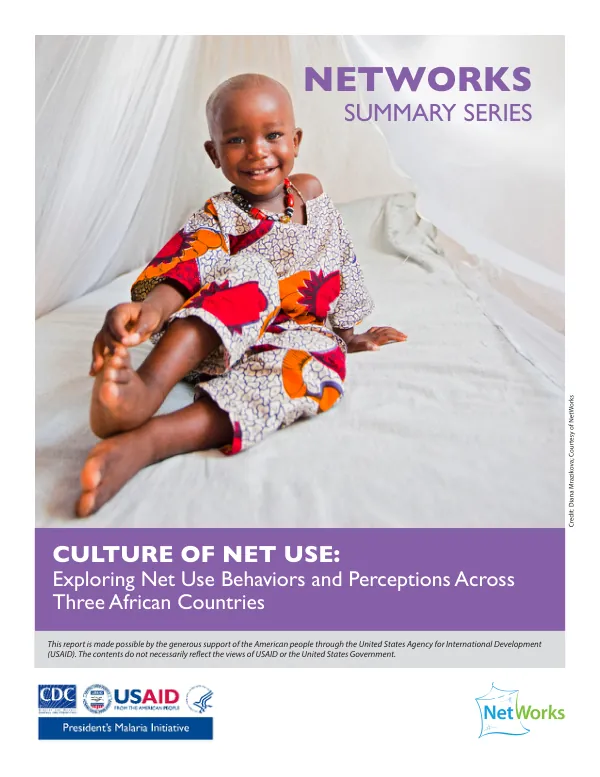
Culture of Net Use: Exploring Net Use Behaviors and Perceptions Across Three African Countries
Sign inCATHOLIC RELIEF SERVICES ORGANIZATION
Culture of Net Use: Exploring Net Use Behaviors and Perceptions Across Three African Countries
In contrast, the Culture of Net Use: Exploring Net Use Behaviors and Perceptions Across Three African Countries report focuses on the use of Insecticide Treated Nets (ITNs) in sub-Saharan Africa.
2015 · 9 pages
Sign in to readA free account is required to download.
Abstract
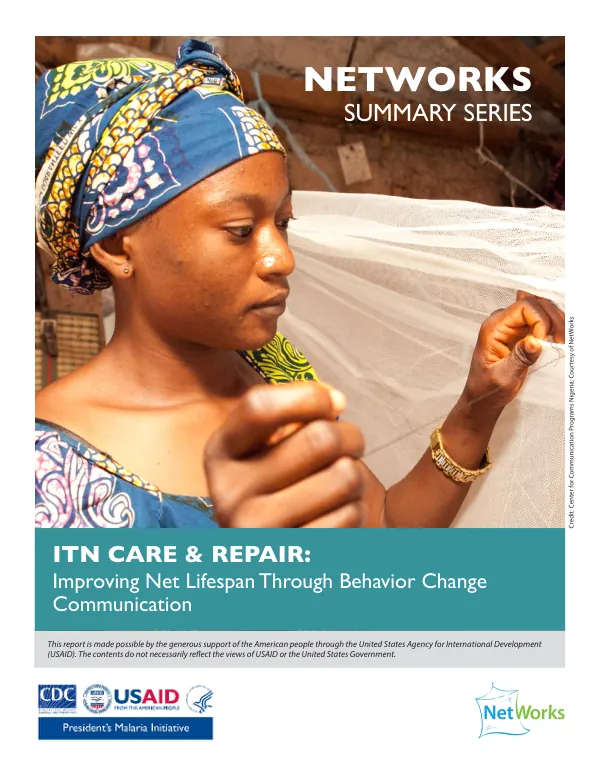
Since 2008, hundreds of millions of nets have been distributed in the region as tools for preventing malaria. Distribution programs typically focus on getting nets into households, but there was little existing research on patterns of net use within the household and determinants of net use. The report highlights the importance of understanding net use behaviors to address barriers to use through social behavior change communication or provision of alternative prevention strategies. The work of NetWorks has initiated a larger dialogue on defining and exploring the culture of net use (CONU), which involves a range of perceptions, attitudes, and behaviors that affect how and why people use nets. The CONU studies used qualitative research methods to explore the context of household net use. These methods were selected to provide rich, detailed information on the topics of interest. The studies were conducted in three countries – Senegal, Uganda, and Mali – and used an iterative process throughout, building on emerging themes to produce expansive information on the topics of interest. Motivations for net use were a key finding of the studies. Most respondents valued nets as an effective tool for preventing malaria by protecting against mosquito bites. They placed nets above other prevention tools, such as spray and coils, and believed that prevention of malaria was better than treatment. In Senegal and Uganda, respondents mentioned that nets have an additional benefit of preventing other pests, such as fleas and mice, from biting at night. Despite the perceived value of nets, many respondents in Senegal and Uganda reported that they were not willing to or able to pay for nets. Thus, they rely on nets distributed through mass campaigns and continuous distribution channels, like antenatal care for pregnant women. Users reported that their inability to pay for replacement nets affected their decisions about retiring nets. Care and repair of nets were also key findings of the studies. The majority of respondents reported washing their nets regularly, but the definition of regularly varied from twice a week to twice a year. In Mali, people reported washing their nets on average once a month. In Uganda, almost half of respondents reported washing their nets every week. Despite the WHO recommendation that LLINs be washed in soapy water and dried in the shade, the study found that nets were most often washed with Omo and dried in the sun. Challenges to nightly net use were also explored in the studies. Recent research has noted that the most commonly reported barriers to net use are discomfort due to heat and perceived lack of mosquitoes. The CONU studies also explored respondents' perceptions of barriers to net use. In Mali and Senegal, however, significant barriers were not found. Respondents mentioned a few bothersome issues with nets but stated that, globally, these did not prevent them from sleeping under nets on a regular basis. Deciding when a net is "expired" was also a key finding of the studies. Respondents disagreed about when nets should be replaced or retired. Some thought that LLINs were effective until a replacement net arrived, either through a mass distribution or routine channel such as antenatal care visits (ANC). Others thought that once a net had a lot of holes, it should be retired. Even when replacement nets were received, many people did not use them if their older net appeared to be in good shape. The visible integrity of the net was the most prominent criteria for respondents for determining whether a net is still useful and how a net is cared for and repaired.
Related documents